
Shopping Cart
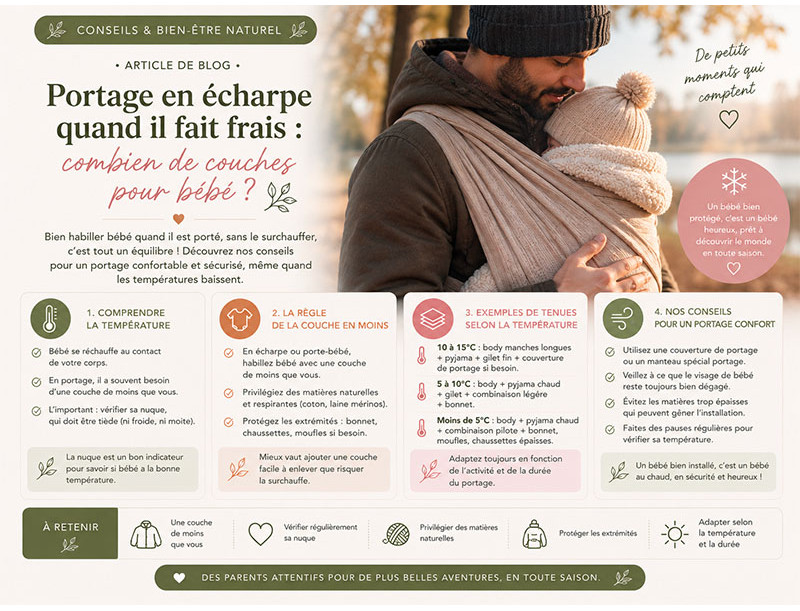
Portage in scarf when it's fresh: how much diapers for baby?
Portage & mid-season
As soon as the mornings fresh, the same question comes back to all the parents with a baby, it is necessary to wrap up baby before installing it in the scarf, or count on the heat of the portage? The answer often surprises, because it goes against the protective reflex: a baby worn needs less diapers a baby stroller, no more. The scarf and the bearer's body are doing a lot of work, and it's overheating, much more than cold, which is watching the little ones too covered.
Portage and Fresh Time: the rule of diapers explained simply
In portage, the scarf counts as a layer of clothes in its own right, and the body of the wearer brings a second by the heat it transmits. A carried baby must therefore be dressed as if to stay inside, with a fine layer in addition to the maximum, never as for a stroller output. Between 10 and 15 ° C, a long-sleeved body, light pants and fine vest are sufficient under the scarf, with a cap and socks. Below 10 ° C, we do not have a baby layer: we cover the carrier and baby set with an open coat, a portage cover or a special portage coat.
Three rules do not suffer any exceptions. The baby face remains clear and visible constantly, never covered by a fabric, a hood or a collar. The thick pilot combination does not have its place in the scarf: it prevents the physiological position in frog and overheats baby. And the verification is done at the neck, which must remain warm and dry, not hands or feet, naturally cooler.
To remember
The scarf is worth a layer, the heat of the wearer is worth another: baby dresses for the interior, not for the outside.
These are the ends that must be covered: head, hands and feet go beyond the scarf and cool the first.
When it's really cold, we cover the carrier duet and baby over, we do not picker on baby.
A thick combination in the scarf is a safety error, not just comfort.
As soon as you enter a store or a heated bus, a baby layer is removed or the carrier is opened.
Why does a baby worn less cold than we believe ?
Portage creates a microclimate. Stuffing against the bust of the wearer, baby enjoys indirect skin skin contact that transmits heat continuously, exactly like during an extended hug. This mechanism is the same as that used to warm up newborns. Adds the scarf itself, whose diapers enveloping fabric form efficient insulation, especially with a thick cotton woven scarf or a doubled panel mei-tai.
What we often forget is that the wearer, him, moves and produces heat. By walking, he warms up and transmits this baby surplus. Result: a baby dressed as for the stroller, then installed in the scarf against a moving parent, is quickly overheated, without being able to report it otherwise than by crying or an unusual falling asleep. Overheating is considered more risky than moderate cold in the infant, which reverses the usual prudence logic.
The reasoning is therefore simple: we count the scarf as a layer, the heat of the wearer like any other, and we dress baby accordingly, that is to say much less than for a stroller output at the same temperature.
15 to 20 ° C
Body long sleeves and light pants. Fine socks, no kit needed except wind.
10 to 15 ° C
A fine vest is added, a light cap and thick slippers or socks.
5 to 10 ° C
Even held, but the duet is covered: open coat of the wearer, cover or coat of portage.
Less than 5 ° C
Closed carrier coat, hot hat, lined slippers, short and neck outings.
How to dress baby under the scarf, layer by layer ?
The principle remains that of diapers fine bunk, found for the whole mid-season. The first layer, in contact with the skin, is a long-sleeved cotton body. The second brings the thermal comfort: a flexible pants, possibly a t-shirt or a fine bra. The third, a lightweight vest, only intervenes below 15 ° C, and it must open easily to be removed without getting out baby from the scarf.
Two practical details make a real difference. Focus on long pants or leggings, because in the physiological position, the baby's legs go back and the short pants discover the calves. Also avoid hooded clothes under the scarf: the hood goes up, plate against the neck and can interfere with breathing or overheat your head.
The extremities: where the cold really spends
Which exceeds the scarf cools, which is in the warm. That's why extremity equipment has more than the number of diapers on the bust. A cap from 15 ° C per windy weather, systematically below 12 ° C. Thick socks or soft wool or leather slippers, who hold on foot and do not fall on the way. Leggings or high socks to cover the area between the pants and the slipper. The mittens, they, are useful only below 5 ° C or if the hands come out of the scarf.
When it's really cold: cover the duet rather than grab to baby
Below 10 ° C, temptation is to add a baby to baby. That's exactly what to avoid. More baby clothes, it is less contact with the heat of the wearer, a physiological position compromised and a risk of overheating as soon as the carrier works. The good strategy is to cover the set: the carrier puts on its open coat over the scarf, or uses an accessory designed for that.
Three solutions exist. The wealth of carriage, the simplest and cheapest, sets on the scarf or baby carrier and withdraws into a gesture at the entrance of a heated place. The porter coat, with a punch that encompasses baby, offers the best comfort for long and winter outings. The coat extension, finally, fits into the zipper of an existing coat and allows to close it around baby without changing it.
Whatever the option, the baby face remains completely cleared, at fuck height, visible with a simple look down. Nothing has to cover his nose or mouth, neither the coat collar, nor a cloud cover, nor a fabric of the scarf. This is the basic security rule of carriage, and the cold does not change it.
Our selection
A woven scarf to wear baby warm all autumn
Thick cotton, soft and breathable: the scarf acts as an insulating layer and is tonsped in some gestures, for comfortable outputs even when morning fresh.
Frequent errors that overheat or cool baby
The most common is the thick pilot combination in the scarf. It prevents legs from retiring in the physiological position, removes baby from the wearer's body and makes it sweat from the first steps. It is adapted only to the stroller or car seat, never at the portage. The second mistake is to maintain the same hold by entering a tray, a transportation or a heated housing: Baby then passes in a few minutes from an environment at 8 ° C to an environment at 22 ° C, always wrapped. It is necessary to open the coat and remove the cap from the entrance.
Third error, more discreet: to rely on hands and feet to judge so baby cold. In the infant, the extremities are naturally cooler than the trunk, including when everything is fine. The only reliable indicator remains the neck, or the upper back, slid under the collar: warm and dry, everything is fine; moist, we live; Frankly cold, we cover the duet. The signs of overheating to know are a very red face, wet hair under the cap, fast breathing and unusual drowsiness. For all the benchmarks by temperature, our article How to dress baby at the end of summer details the logic of diapers which also applies to the stroller and at night.
Checklist before an exit in fresh weather
Dress up baby as for the interior, a fine layer in addition to the maximum
Bonnet, thick socks or slippers, leggings if the pants goes back
No thick combination or hood under the scarf
Plan what to cover the duet: open coat, cover or coat of carriage
Check that the baby face remains clear and visible
Check the neck after ten minutes of walking
Open the mantle and remove the cap from the entrance to a heated place
FAQ
Should we put a baby coat in the scarf ?
Not. The coat or thick combination hinders the physiological position and overheats baby against the wearer. Below 10 ° C, we cover the carrier and baby assembly with an open coat, a porting cover or a porting coat.
How do you know if baby has too hot in the scarf ?
We slide two fingers under the neck, on the neck or the upper back. A moist or clearly hot skin, a very red face, wet hair or unusual drowsiness report overheating: the cap is removed and the coat is open without waiting.
Does a woven scarf warmer than a sling ?
Yes, significantly. A thick cotton woven scarf tied in several passages forms an insulation much greater than a single thick sling or a fine expandable scarf. With a woven scarf, we gladly remove a baby back on.
Can we wear a newborn out when it's cold ?
Yes, the portage is even one of the most effective ways to keep it warm. We favor short outputs, one covers the head and the feet, we protect the duo of the wind and we regularly check the neck and the face, which must remain clear.
The word of the end
Wear baby when it is fresh asks mostly to disengage a reflex: that of covering it more. The scarf and the heat of the wearer do the essentials, the ends require attention, and it is the duet that we protect the cold, not baby alone. With these three ideas in mind, the porting remains possible and pleasant all autumn, and even a good part of the winter.
At Mom and Nature Baby, we love portage for what it brings on a daily basis: hands-free, contact and shared heat. Some outfit adjustments are enough to enjoy it by all time.
This article has an informative purpose and does not replace the support of a porting instructor or medical advice. Whatever the temperature, the baby face must remain clear and visible, in the physiological position, with the free airways. If in doubt about baby tolerance cold or heat, ask for advice to a health professional.