
Shopping Cart
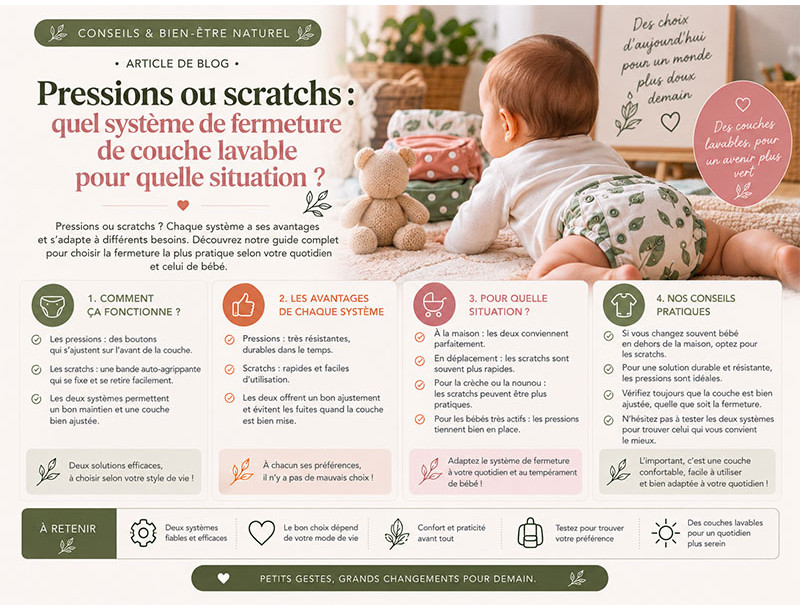
Pressures or scratches: which washable layer closing system for what situation?
Diapers washable & buying guide
When choosing his diapers washable, we compare the materials, the inserts, the TE1 or TE2 models, and one often forgets a detail that, however, condition the daily for two and a half years: the closure. Pressures or scratches, it is not just a matter of taste. The selected system influences the speed of the exchange, the accuracy of the setting, the life of the layer, its manipulation by a third person and, later, the ability of a toddler to open it alone. Here's how to decide according to your real situation, not according to the mode of the moment.
Pressures or scratchs: what really changes the closing system
Scratchs (self-gripping closure) offer continuous adjustment with a millimeter and a two-second closure, intuitive for anyone accustomed to diapers disposable. Their limit is wear: the hooks joke of fiber and lose their grip after twelve to eighteen months of intensive use, and a child can open them alone as early as twelve to eighteen months. The pressures offer a notch adjustment, a little less accurate and slower to tame, but they do not wear out almost, resist several children and face a curious toddler.
In practice: Scratchs for a newborn, for a nanny or unfamiliar grandparents of the washable, and for the parents who start; Pressures for prolonged use, a second child, a future resale or toddler that begins to explore his layer. Many families combine both, allowing you to take advantage of each system at the right time.
To remember
The scratches gain on the speed and accuracy of the adjustment, the longevity and safety pressures against small hands.
The closure only applies to size: the height adjustment, on both systems, is by pressures and makes the scalable layer.
A scratch layer is profitable on a child, a two or three pressure layer.
Scratches require specific maintenance: folded washing tabs, cleaned hooks, no strong heat dryer.
The right choice depends on who changes baby, at what age, and how long you intend to use your diapers.
How do both systems work ?
On a washable layer, you have to distinguish two settings that have nothing to do. The first is the height, or "rise": a series of pressures on the front of the layer makes it possible to shorten it for a newborn and to lengthen it as baby grows. This setting exists on virtually every diapers evolving, regardless of their closing system. The second is the closure at the waist, that is, the way the fins come together on the baby belly: it is where we choose between pressures and scratchs.
The pressures are small resin buttons, arranged in two rows on the front of the layer. Each fin comes to clip on the corresponding row, with usually two pressures per side to prevent the layer into the thighs. The setting is crranched by Cran, choosing the most suitable pressures of the moment.
The scratches, also known as self-gripping closures, Velcro or Aplix of the names of the most famous brands, work as on a disposable layer: a band of hooks on each fin comes cling to a strip of curls sewn on the front. The setting is continuous, without notch, and one can tighten or loosen with a simple gesture. Most models incorporate washing tabs that protect the machine brackets.
Speed of exchange
Scratchs: two seconds, one hand. Pressures: a few more seconds, especially with a baby who is gig.
Adjustment accuracy
Scratchs: Continuous adjustment to a millimeter. Pressures: Checken adjustment, sometimes between two positions.
Longevity
Pressures: several children without weakening. Scratchs: Hanging that declines after 12 to 18 months intensive.
Toddler resistance
Pressures: difficult to open alone. Scratchs: uncomfortable from 12 to 18 months by a curious child.
Scratches: fast, accurate, but perishable
The great advantage of the scratches is the precision. On a newborn in the ride of the fluctuating waist, or on a baby in a round belly between two notches of pressures, the continuous closing allows an exact fit, without yawning or compression. It is also the most intuitive system: a nanny, a grandmother or a dad reluctant to diapers washable find the gesture of the disposable and adopt it in a single demonstration. In the early morning, with a baby that squirms, closing in one hand saves valuable time.
The reverse is wear. The hooks are loading with fibers and stuffed to each wash, which gradually reduces their power of grip. With intensive use, five to seven foreign exchange per day, the band loses significantly in efficiency after twelve to eighteen months: the layer opens at least traction, and we end up relegating to diapers rescue. Another point, the scratch hangs everything that goes into machine: bodys, inserts, wipes are eroded if the washing tabs are not folded, and the loop band is damaged in contact with other textiles.
Finally, the scratch has a natural opponent: the toddler. Between twelve and eighteen months, many children discover that the layer opens with a satisfactory noise, and preferably do it during the nap. This is not anecdotal: it is often why parents equipped with scratchs are buying pressure for the second year.
How to prolong the life of a scratch closure ?
Three gestures make a real difference. Systematically fold the washing tabs before putting the layer to the dirty. Clean the hooks once a month with a nail brush, a fine comb or another band of hooks rubbed on it, to remove accumulated fibers. And avoid strong heat dryer, which softens the hooks and accelerates their wear: the free-air stretch remains the best allied scratchs, such as PUL else.
Pressures: durable, safe, a little more demanding
The pressure is almost no life. A properly maintained pressure layer crosses two or three children without the closing weakening, making it the logical choice as soon as you plan a second baby, a resale or a gift. She clings to nothing in machine, does not ask for any particular maintenance, and holds good facing a child who pulls on it. For the nights, it is also a guarantee: a layer that does not open for twelve hours of restless sleep.
His disadvantages are handling. Crans adjustment can fall between two positions on some morphologies: a little too loose on a notch, a little too tight on the next. The gesture requires a slight learning, and close four pressures on a baby who turns takes a few seconds more than a scratch. This detail, anodin at home, can slow down a nanny or a little accustomed nursery: it is worthwhile to make a demonstration and leave a layer already set to good cran. Our article on the diapers washable and nanny details how to prepare this transmission.
One last point generally reassures parents: modern polyacetal resin pressures are very resistant, and a pressure that breaks remains exceptional on a quality layer. If necessary, it is replaced with a pressure tongs, an inexpensive tool that many adept families of the washable are possessed.
Which system for what situation ?
For a newborn, the scratch has a real advantage: the waist trick quickly changes, the belly is sometimes prominent, and the continuous adjustment marries the morphology without compression on the cord in course of healing. The pressures remain quite usable, provided that you agree to change the first weeks.
If baby is guarded by a nanny, grandparents or a nursery, the scratch simplifies third parties adhesion and reduces the risk of poorly closed layer. If you hold pressures, a time of taking in hand and some diapers pre-regulated the question in the vast majority of cases.
For long use, a second child or resale, the pressures are needed: the closure will not move, and a pressure layer is better receiving that a tired scratch layer. For a toddler who explores, who withdraws his diaper to the nap or playing with closures, the pressures are almost unavoidable in the second year. And for the nights, the decisive criterion is the outfit: a well-placed pressure does not yield, where an end-of-life scratch can let go in the early morning. For all other criteria of choice, model, size, insert material, our guide How to choose your diapers washable completes this article.
Should one choose a single system or mix ?
Mix is often the smartest solution. A few diapers at Scratchs for the first months, the nanny and the Express Changes, and a main stock for duration, nights and second year. This distribution makes it possible to take advantage of the precision of the scratch when it really counts, without depending on a system that wears out. If the budget imposes a single choice, pressures remain the safest option for the entire period of diapers.
Our selection
Of diapers evolutionary washable, birth to cleanliness
TE1, TE2, full bamboo, start kits and newborn: Find the model and closing adapted to your daily lives, batch or unit.
Frequent errors with one and the other system
With the scratches, the classic error is to forget the washing tabs: In three months, the hooks are full of fibers and the curl band is damaged by the friction of other textiles. Then comes the tumble dry too hot, then excessive tightening to compensate for a catching hook, which marks the baby's skin without improving the outfit.
With the pressures, the most common error is the wrong notch: a closed layer too loose leaks to the thighs, a too tight layer leaves brands and compresses the belly after the meal. The right setting is satisfied with a finger that passes without force between the layer and the skin, to the thighs as at the waist. Second trap, only clink one pressure per side on a model that provides two: the ailet with thigh, and it's the leak insured as soon as baby sits.
Checklist to choose his closure
Who changes baby on a daily basis: parents only, or nanny, nursery, grandparents ?
How long do you intend to use the diapers : a child, or many ?
Do you plan to sell or give your diapers then ?
Is baby a newborn with a changing belly, or a toddler who explores ?
Do you use a tumble dryer regularly ?
The diapers will they serve at night, where the outfit premium on speed ?
Are you planning to mix the two systems according to the moments ?
FAQ
Do the washable layer scratchs last long ?
With intensive daily use, the grip declines clearly after twelve to eighteen months. Good maintenance (folded tongues, cleaned hooks, air drying) extends this duration, but the scratches remain the only wear element of the layer.
Does a pressure layer suitable for a newborn ?
Yes, as long as you adjust the height and change the size of size as baby grows up, which happens quickly the first weeks. The continuous scratch adjustment is simply more comfortable at this age, without being essential.
My child withdraws his layer at scratchs, what to do ?
It is common as early as twelve to eighteen months. A body closed over the layer often sets the problem in the short term. Over the duration, the passage to pressures, more difficult to open alone, is the most reliable solution.
Can we replace a worn scratch or broken pressure ?
Broken pressure is replaced with a pressure clamp in a few minutes. A worn scratch can be cured by a seamstress or a retouching workshop, but the operation often costs almost as much as a new layer.
The word of the end
There is no perfect closing, but a closure adapted at each moment: the scratch for its precision and its simplicity the first months and in unusual hands, the pressure for its solidity over the duration, nights and second year. Ask the closing question before buying is avoiding redeeming a full stock twelve months later.
At Mom and Nature Baby, we prefer the diapers who last and who adapt to the real life of families. Well-set, well maintained, a washable layer accompanies baby from birth to cleanliness, and often the following.
Leave your reply Cancel Reply