
Shopping Cart

The Montessori sensory bin
Are you looking for a fun activity for your little one? There's nothing better than a sensory activity to keep them entertained and nurture their appetite for discovery and learning. Between 0 and 3 years old, your child discovers the world around them through their 5 senses, and develops their skills (speech, walking, continence, social relationships...). How can a sensory bin help your child grow?
What is a sensory activity?
The senses help to establish in your little one notions that will serve them throughout their entire life in understanding the world around them. Sensory activities allow children to engage their senses on a daily basis at home.
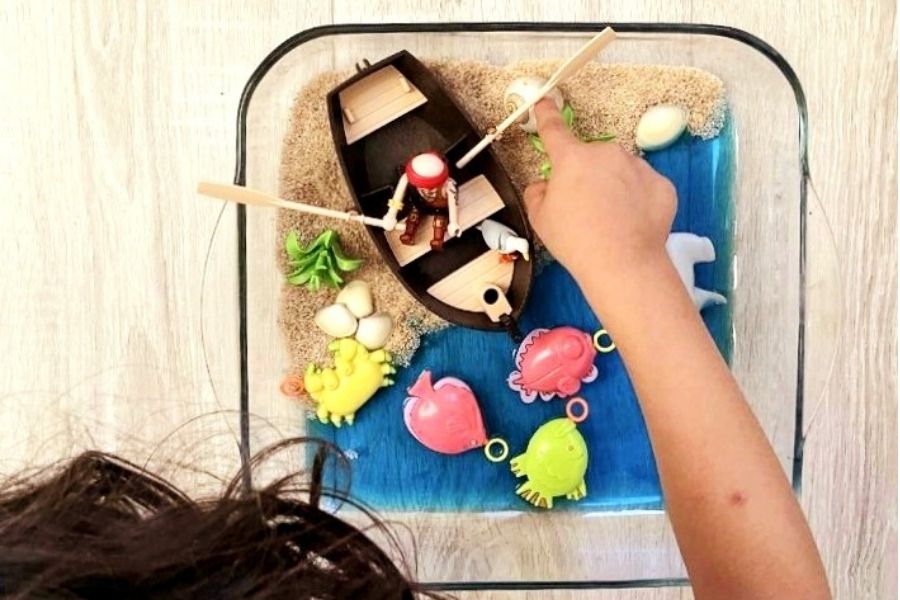
Why make a sensory bin?
A sensory bin is an activity that is just as enjoyable as it is stimulating. It brings a lively dimension to a child's learning, and children need to be active participants in their own learning in order to absorb what they learn quickly, with enjoyment, and over the long term.
Indeed, it is far more fun for a baby to handle figurines than to simply learn an animal's name from a nomenclature card. They can truly explore animals: How many legs or wings do they have? Do they swim, fly or crawl? This also helps to enrich their vocabulary, improve their concentration, and unleash their imagination.
Moreover, a sensory bin helps to develop your child's fine motor skills: Give them tongs, a fishing rod, a spoon, a pipette, or a colander, etc. They can then pick up, transfer and even sort the contents of the sensory bin.
Finally, these activities directly aim to stimulate all 5 of your child's senses:
- Sight through the different colours
- Touch through the various textures and objects that make up your bin
- Hearing during play and exploration,
- Smell through aromatic plants
- Taste by including edible elements, why not.
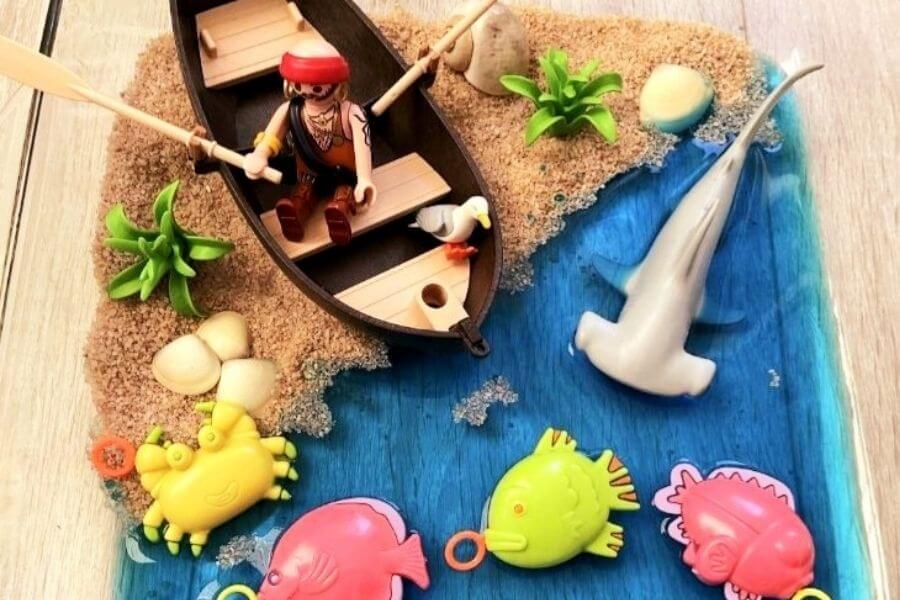
But how do you make a sensory bin?
1) Choose a theme. (At the seaside, welcoming spring, a building site, a farm frenzy, around a colour or a profession...) It would be best to choose a theme related to outings you have already done together, or based on a question your child has had, in order to capture their interest.
2) Place in a container (transparent if possible) one or several base materials such as pasta, rice, sand, soil, water, or jelly...
3) Finally, set the scene for your theme with chosen elements (playmobil, toy cars, figurines...)
A sensory bin can be extended infinitely, across multiple themes and different materials... Don't set yourself any limits — follow your little one's interests and, above all, their sensitive periods. You could, for example, bury objects to find, or hide numbers and letters.
There's no need to set a budget — don't hesitate to create your sensory bin using what you already have at home: dried pulses, water coloured with food colouring, cereal, gravel, herbs, leaves, flowers, etc. You can also add your children's toys such as playmobils, toy cars, small balls... Don't hesitate to make the most of your outings to collect what you'll need. A trip to the beach is all it takes to gather sand and shells, and a walk in the woods to collect soil, leaves, and pine cones.
Things to know before offering a sensory bin to your child
It is essential that you enjoy what you are presenting to your baby, because if you're not enthusiastic about it, they will sense it and show no interest in the activity.
It is important to always stay with your child during this activity, due to the small toys and inedible elements they might put in their mouth. It is also very important to wash your hands before and after the activity. Finally, for extra peace of mind, place a tablecloth or an old sheet under the bin to avoid making a mess of the whole room.
Leave your reply Cancel Reply