
Shopping Cart
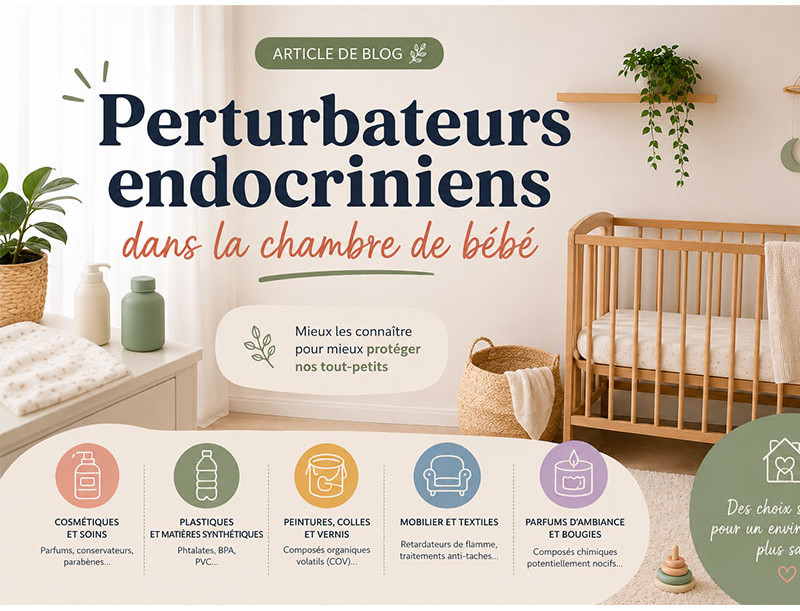
Endocrine disruptors in the nursery: how to reduce everyday exposure
Environmental health & the nursery
When preparing the nursery, we tend to think about decoration, the cot or storage. We think less about the chemical substances present in the air, dust, furniture, textiles or certain fragranced products. Yet during the first months of life, baby is particularly vulnerable. Here is what you need to know about where endocrine disruptors — and indoor air pollutants more broadly — can lurk in the nursery, and how to make safer choices without descending into anxiety.
Not every product in the nursery necessarily contains endocrine disruptors, and not every indoor air pollutant is one either. But within a single room, multiple sources can accumulate: paints, adhesives, new furniture, mattresses, textiles, floor coverings and fragranced products. The goal is therefore not "zero" — an impossible standard — but a reasonable and effective reduction in exposure.
Key takeaways
Endocrine disruptors are substances capable of interfering with the hormonal system.
Pregnancy, early childhood and — more broadly — periods of child development are particularly sensitive windows.
In the nursery, exposure can come from indoor air, dust, materials, furniture, textiles and fragranced products.
The most useful steps are simple: ventilate every day, limit sources of emission, avoid fragranced products, and plan any building work well before baby arrives.
Choosing low-emission, unfussy products is often more effective than multiplying sprays, diffusers or "fragranced" solutions.
What are endocrine disruptors?
According to the WHO, as cited by French health authorities, an endocrine disruptor is a chemical substance of natural or synthetic origin that may interfere with the functioning of the hormonal system. Substances frequently cited include certain bisphenols, phthalates, parabens, pesticides, flame retardants and certain perfluorinated compounds. These substances can enter the body through food, the air we breathe or via skin contact.
The French Ministry of Health also recalls that France has put in place a national strategy to reduce the population's exposure to these substances and improve consumer information.
Why is baby more vulnerable?
The early years of life are a period of intense development. The 1000 premiers jours website notes that certain endocrine disruptors may act more strongly during a child's development, from pregnancy through to the end of puberty. This explains why prevention recommendations target pregnant women, newborns and young children as a priority.
Santé publique France points out that the entire population is exposed to endocrine disruptors present in the home, packaging, coatings, personal care products and the indoor environment — making their prevention a major public health issue.
Where can they lurk in the nursery?
In a recently decorated nursery, several sources can contribute to indoor pollution: paints, varnishes, adhesives, building materials, new furniture, mattresses, textiles, floor coverings and fragranced objects. The Anses notes that indoor air can contain volatile organic compounds (VOCs), as well as phthalates and other pollutants released by furnishings, decoration products or everyday household habits.
It is worth bearing in mind that we are not talking solely about "pure" endocrine disruptors, but about a mixture of indoor pollutants. Reducing overall emissions in the nursery therefore helps to create a healthier environment day to day.
Paints and wall coverings
Some paints and wall coverings can release VOCs, particularly after building work or during drying.
New furniture
Furniture, especially when brand new, can release chemical substances into the indoor air.
Mattresses and textiles
Some textiles, foams, stain-resistant treatments or synthetic materials can contribute to indoor emissions.
Dust and fragranced products
Dust concentrates various pollutants, whilst candles, incense, room fragrances and sprays add unnecessary emissions.
Building work before baby arrives: something not to overlook
If the nursery needs repainting or new furniture, it is best to plan ahead. Ameli recommends avoiding building work during pregnancy where possible, and if changes are necessary, finishing them well before the birth so the room can be ventilated thoroughly to clear the pollutants released during the work.
The ADEME points out that wall paints can release volatile organic compounds, and that some of these pollutants are particularly concerning. On products such as wall coverings, paints, partition boards, panels and carpets, a label indicates the level of indoor air emissions, rated from A+ to C. Opting for A+-rated products is therefore a worthwhile habit for the nursery.
Which materials and objects deserve extra caution?
For the nursery, simplicity is the best approach: fewer pieces of furniture, low-emission materials, unfussy finishes, and avoiding an accumulation of fragranced decorative objects. The ADEME notes that furniture can also release VOCs, whilst carpet and certain fixing adhesives both release pollutants and trap more allergens and dust. [Source](https://agirpourlatransition.ademe.fr/particuliers/proteger-sante/eviter-polluants/proteger-enfants-pollution)
By the same logic, heavily fragranced products are not a sign of cleanliness. Room fragrances, scented candles, incense, air freshener sprays, strongly scented laundry detergents or fragranced cleaning products can all degrade the air quality in the nursery.
Practical checklist for a healthier nursery
Ventilate the room every day, for at least 10 to 15 minutes, even in winter
Do not block ventilation openings and keep the ventilation system well maintained
Finish building work several weeks before baby arrives
Choose paints, coverings and materials rated A+ where labelling exists
Limit new furniture to the strict minimum
Avoid carpet in the nursery if possible
Avoid candles, incense, diffusers, fragranced sprays and essential oils in the nursery
Clean using simple, lightly fragranced products
Dust regularly with microfibre cloths or a vacuum cleaner fitted with a HEPA filter
These steps are consistent with the advice from Ameli, the ADEME and the Anses for improving indoor air quality and reducing avoidable exposures in the very young.
What about cleaning the nursery?
There is no need for harsh products to clean effectively. Ameli recommends using appropriate products — with an environmental label where possible — limiting their use and ventilating during and after cleaning. Simple solutions such as white vinegar, black soap or bicarbonate of soda are sufficient in many situations, without needing to add essential oils.
The Anses also stresses the role of everyday habits in indoor air quality: cutting down on sprays, air fresheners, scented candles and combustion sources is among the most effective measures available.
Should all plastics be avoided?
It is not always realistic to avoid plastic entirely, but certain substitutions make sense, especially for frequently used items. The 1000 premiers jours website highlights bisphenols as among the best-known substances of concern, and notes that in Europe bisphenol A has been banned in baby bottles, and in France in all food-contact materials.
In the nursery, this is mainly a prompt to avoid unnecessary objects made from soft plastic, heavily fragranced or low-quality products, and to favour durable, simple objects that are easy to clean.
FAQ
Are endocrine disruptors only found in toys?
No. They can be found in many everyday objects and materials: the home environment, packaging, coatings, personal care products, household dust and furniture.
Is ventilating enough to solve everything?
No, but it is one of the most effective steps. The ideal approach is to combine daily ventilation with reducing emission sources and choosing low-emission products.
Are diffusers and essential oils a good idea in the nursery?
It is best to avoid them. Ameli already advises against essential oils during pregnancy, and more generally fragranced products or anything diffused into the air are not recommended in baby's environment.
What is the first step I can take today?
Open the window every day, remove room fragrances from the nursery, and avoid bringing in too many new or fragranced products. These are simple, concrete and genuinely useful measures.
Final thoughts
Protecting baby from endocrine disruptors in their nursery does not mean changing everything or aiming for perfection. It is mainly about making a few sensible choices: planning building work in advance, ventilating, simplifying, avoiding room fragrances, selecting low-emission materials and not overcrowding the room.
When it comes to environmental health, the most understated steps are often the best. A calm, uncluttered, well-ventilated and lightly fragranced nursery is already an excellent foundation for welcoming baby into a healthier environment.
This article is intended for informational purposes only and does not replace the recommendations of a healthcare professional. If you have specific questions about baby's environment, do not hesitate to discuss them with your midwife, paediatrician or doctor.