
Shopping Cart
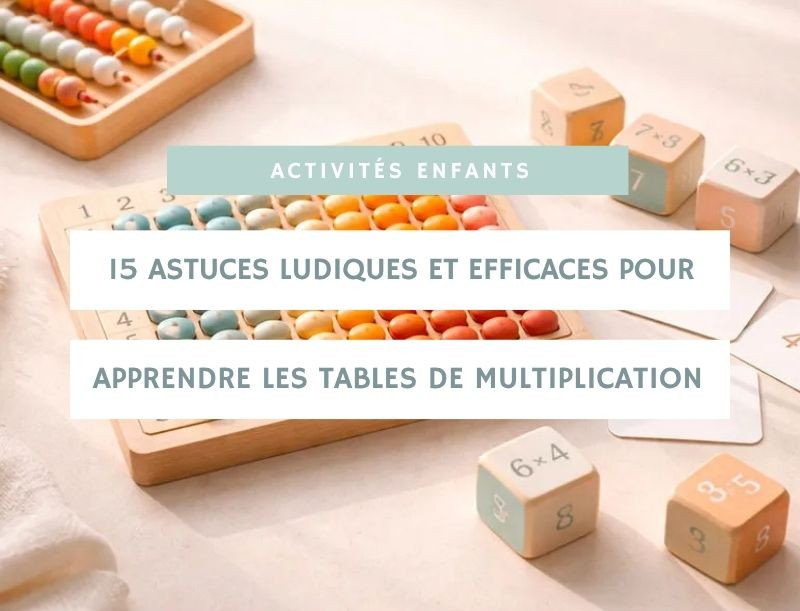
15 fun and effective tips to help a child learn their times tables
Learning times tables is often a challenging milestone in a child's schooling. Between the ages of 7 and 9, in Year 2 and Year 3, they must memorise these sequences of numbers, which can seem abstract and tedious. And yet, mastering the times tables is fundamental to progressing in maths and building self-confidence. The good news? There are plenty of fun, visual, and creative methods to turn this learning process into a moment of joy and togetherness. Let's explore 15 concrete tips, tried and tested by teachers and parents alike, to support your child towards mathematical success with kindness and effectiveness.
Why are times tables so hard to learn?
Before we discover the tips, let's understand why this learning process poses so many difficulties for our children. This understanding will help us tailor our support with greater kindness and effectiveness.
A significant cognitive load
Learning the times tables from 1 to 10 means memorising 100 different results. Even if certain tricks help reduce that number (the 1, 2, 5 and 10 times tables being easier, and the commutativity of multiplication), it remains a substantial volume of information to encode into long-term memory.
At 7–8 years old, a child's working memory is still developing. It can process around 3 to 5 pieces of information simultaneously, which explains why sequences such as "7 × 8 = 56" require considerable effort.
An abstract type of learning with no concrete support
For many children, numbers remain abstract. Unlike counting objects ("I have 3 apples"), multiplying 7 by 8 does not necessarily correspond to a tangible reality in their everyday life. This disconnect between the mathematical concept and concrete experience makes memorisation harder.
Academic pressure and performance anxiety
Timed tests, surprise quizzes, and comparisons with classmates generate stress that blocks learning. Maths anxiety, documented by a great deal of research, disrupts working memory and creates a vicious cycle: the more the child stresses, the less they remember; the less they remember, the more they fail; the more they fail, the more they stress.
The role of parents:
Your role is not to recreate school at home, but to create a relaxed and playful environment where learning becomes a game rather than a chore. The tips that follow are rooted in this positive and encouraging philosophy.
Visual and hands-on tips
Many children are visual and kinaesthetic learners: they understand and remember better when they can see and touch. Let's make the most of this natural ability!
1. The Pythagoras table: a powerful visual tool
The Pythagoras table (or multiplication grid) is a double-entry table that displays all results from 1×1 to 10×10. Its strength? It makes several fascinating mathematical patterns visible.
How to use it effectively:
Print a large colour version and display it in the bedroom
Point out the diagonals (square numbers: 1, 4, 9, 16...)
Show the symmetry: 3×7 = 7×3 (commutativity)
Colour by family: the 2 times table in blue, the 5 times table in green, etc.
Use it as a game: close your eyes, point randomly, and test yourself!
2. Hands-on materials: cubes, beads, Lego
Making multiplication tangible with objects helps move from abstract to concrete. Use whatever you have to hand:
Cubes or building blocks: For 3×4, make 3 rows of 4 cubes
Beads or buttons: Group them into identical sets
Lego: Build rectangles (e.g. a rectangle of 5 bricks by 6)
Seeds, pebbles, pasta: Free natural materials that work wonderfully
Egg boxes: Perfect for visualising 2×6, 3×4, etc.
This hands-on approach helps children understand that multiplying means adding the same number several times. This deep understanding will then make memorisation easier.
3. Drawing and diagrams: draw your multiplication!
Encourage your child to draw their multiplications. For 4×3, they could draw 4 groups of 3 stars, 3 trees with 4 apples each, or anything else that inspires them.
Creating visual stories around multiplications anchors them in the memory. "7 dwarfs live in 8 houses = 56 dwarfs in the village altogether!" Absurd? Perhaps, but effective!
Auditory and rhythmic methods
Some children remember better through listening and rhythm. Music and rhymes are powerful allies for embedding times tables in the memory.
4. Songs and rhymes for the times tables
There are many educational songs specially designed to help children learn their tables. On YouTube, Spotify, or dedicated apps, you'll find catchy tunes that turn the times tables into memorable refrains.
Recommended resources:
YouTube channel "Les tables de multiplication en chansons"
App "Multimalin" with mental stories
Audio CD "Mes premières multiplications en musique"
Create your own family rhymes using familiar tunes
The advantage? Your child can listen to them in the car, in the shower, before bed... Natural spaced repetition does its work without any conscious effort!
5. Rhythmic recitation and clapping
Turn recitation into a rhythmic game:
Clap your hands at each number: "5" (clap) "times" (clap) "3" (clap) "equals" (clap) "15" (clap)
Jump on the spot while reciting the table
Use a metronome to create a steady beat
Invent a simple dance routine for each table
Movement activates several brain areas simultaneously, strengthening memory encoding. It's also far more fun than monotonous recitation!
Games and fun activities
Turning learning into a game is probably the most effective strategy. When you're having fun, you learn without even realising it!
6. Flashcards used as a game
Make or buy flashcards: one side shows the multiplication (7×8), the other the answer (56). But no dull recitation! Turn them into games:
Game variations with flashcards:
The timer challenge: how many cards in 1 minute? Beat your record
The pyramid: stack correct cards, start again on a wrong answer
The fishing game: cards face down, pick one and answer
Multiplication memory: match the sum with its answer
The battle: the highest product wins the round
7. Educational board games
Several board games are excellent for practising multiplication in a fun way:
Multiplodingo: a progressive and entertaining card game
Tam Tam MultiMax: speed and memorisation
Cartatoto Multiplications: several rules to play with
The floor mat game: step on the correct answers
The advantage of board games? The whole family joins in, creating a moment of togetherness around maths rather than a stressful revision session.
8. Apps and digital games
In the digital age, many well-designed educational apps make learning interactive and motivating:
Recommended apps (iOS/Android):
Kahoot!: customisable interactive quizzes
Monster Numbers: a fun adventure game with multiplications
Photomath: step-by-step visual explanations
AB Math: progressive and adaptive exercises
Montessori Math Multiplication: a concrete and visual approach
Important: Limit screen time (15–20 minutes maximum) and always prioritise human interaction and physical play as the foundation of learning.
9. Challenges and obstacle courses
Create a physical course around the house or garden: at each stage, a multiplication to solve before moving on. Combine movement with thinking:
Jump 6 times on one foot = 6 times table
Throw a ball into numbered hoops
Obstacle course with questions at each station
Treasure hunt with maths riddles
Memory and mnemonic tips
Some tables are harder than others. Mnemonics and mathematical tricks help get around these hurdles.
10. Mathematical tricks to make things easier
Techniques for each table:
2 times table: Double it (easy!)
3 times table: Count up in 3s on your fingers
4 times table: Double the double (4×6 = double 12)
5 times table: Always ends in 0 or 5
6 times table: Use (5×n) + n
7 times table: The hardest one — needs repetition
8 times table: Double the 4 times table, or (10×n) - (2×n)
9 times table: The magic finger trick (see below)
10 times table: Add a zero (super easy!)
11. The magic 9 times table finger trick
This age-old technique never fails to fascinate children, and it works a treat:
The finger method for 9×n:
Hold out all 10 fingers in front of you, palms facing down
For 9×4, fold down the 4th finger (counting left to right)
Count the fingers before the folded finger = 3 (tens)
Count the fingers after the folded finger = 6 (units)
Result: 9×4 = 36!
This trick works for the entire 9 times table, from 9×1 to 9×10. Magical and foolproof!
12. Mental stories (the Multimalin method)
The Multimalin method, developed by Matthieu Protin, uses vivid stories to create strong mental associations. Each number becomes a character, and each multiplication becomes a little story.
For example: for 7×8=56, you imagine a cowboy (7) throwing his lasso (8) and catching a monkey (56). The absurd but visual story lodges itself deep in the memory.
You can buy the full method or invent your own stories together with your child, which further strengthens memory encoding through shared creativity.
Organising the learning process
Beyond the techniques themselves, how should you organise learning to maximise effectiveness whilst keeping motivation alive?
13. Adapted progression: one table at a time
Don't overwhelm your child by trying to learn everything at once. Work through things table by table, in a strategic order:
Recommended learning order:
1, 2 and 10 times tables: very easy, builds confidence quickly
5 times table: simple pattern (0 or 5)
9 times table: motivating finger trick
3 and 4 times tables: medium difficulty
6 and 8 times tables: more complex
7 times table: the hardest — save it till last
Spend one week per table (or even two for the trickier ones) before moving on to the next. It is far better to have a solid grasp of a few tables than a vague knowledge of all of them.
14. Short, regular sessions: 10–15 minutes per day
Neuroscience confirms it: spaced repetition is far more effective than a single long intensive session. Favour:
10–15 minutes per day rather than 1 hour on Sunday
Regular slots: after a snack, before dinner
Micro-sessions: 2 minutes in the car, 3 minutes before bed
Variety: alternate methods to keep interest alive
This approach, similar to learning to tell the time, avoids cognitive fatigue and sustains motivation over the long term.
15. Positive tracking and celebrating progress
Create a visual tracking system that recognises every step forward:
Motivating tracking ideas:
Champions chart: colour in the tables mastered
Multiplication tree: one leaf for each table learnt
Skills belts: like in judo, progress to the next level
Tables passport: a stamp for each table completed
Progress chart: visualise improvement over time
Celebrate every win, however small: "You got through the whole 3 times table without a single mistake!", "You beat your speed record!" Positive recognition stimulates dopamine and reinforces intrinsic motivation.
Mistakes to avoid at all costs
Certain parental attitudes, though well-intentioned, can block learning and create a lasting aversion to maths.
❌ Comparing with other children
"Your cousin already knew all his tables at your age", "Emma in your class already knows them"... These comparisons destroy confidence and breed anxiety and discouragement. Every child learns at their own pace.
❌ Punishing mistakes or poor marks
Making mistakes is a normal part of learning. Punishment creates a negative association with maths and inhibits the intellectual risk-taking needed to progress.
❌ Forcing long, tedious sessions
Making a tired child recite for 45 minutes turns the times tables into torture. Always favour quality over quantity, and stop at the first signs of disengagement.
❌ Passing on your own maths anxiety
If you yourself struggled with maths, avoid phrases like "It's normal — I wasn't good at it either", or "Maths is hard". These beliefs rub off and become self-fulfilling prophecies.
❌ Not linking to real-life situations
Tables learnt mechanically, without understanding the concept of multiplication, remain fragile. Always connect them to everyday situations: "If each tart has 6 slices and we make 4 tarts, how many slices altogether?"
Weaving times tables into daily life
The best revision is the kind that doesn't look like revision! Naturally incorporate multiplication into everyday life.
In the kitchen
"We're making cookies. If we put 5 chocolate chips on each cookie and we make 8 cookies, how many chips altogether?"
Doubling a recipe: multiply all ingredients by 2
Counting eggs in boxes (6×2, 6×3...)
While shopping
"These yoghurts cost £3 for a pack of 4. If we take 3 packs, how many yoghurts is that?"
Calculate the total price of identical items
Compare pack sizes (6×150g vs 4×200g)
In the car
Number plate game: multiply two digits
"We're driving at 70 mph. In 3 hours, how far have we gone?"
Quick challenges: "7 times table before we reach the roundabout!"
In games and leisure activities
Video games: "You have 8 lives with 3 hearts each — how many hearts in total?"
Sport: "9 players per team, 4 teams — how many players altogether?"
Building: "6 floors of 7 blocks each..."
Frequently asked questions about learning times tables
At what age should children learn their times tables?
Times tables are officially introduced in Year 2 (age 7) with the 2, 3, 4 and 5 times tables. Year 3 (age 8) deepens understanding and adds tables up to 10. That said, some children may start earlier if they show an interest, while others will need more time. Always respect your child's own pace.
How long does it take to master all the times tables?
With regular practice (10–15 minutes per day), a child can master all the times tables in 2 to 4 months. But bear in mind: "mastering" means responding quickly and confidently, not just having a vague awareness. Full consolidation can take 6 months to a year with spaced revision.
My child keeps getting the tables muddled — what should I do?
This is perfectly normal! Confusion (is 6×7 = 42 or 48?) arises when too many tables are learnt simultaneously without proper consolidation. The solution: go back to basics, work on just one table for a week, then gradually add others whilst always revising the previous ones.
Are times tables really that important?
Yes, absolutely! Mastering the times tables frees up working memory for more complex mathematical operations (division, fractions, algebra). A child who hesitates over 7×8 will waste time and cognitive energy on problems that require this basic skill. It's like reading: you need to decode automatically in order to understand the text.
Should you learn the tables in order or randomly?
Both! First, learn in order (3×1, 3×2, 3×3...) to understand the pattern. Then, once the table is known, practise out of order (3×7, 3×2, 3×9...) to check for genuine mastery. Shuffled flashcards are excellent for this phase.
My child is stuck on one particular table — how can I help?
The 7 times table is often the hardest. Specific strategies:
Create a personalised song just for that table
Use absurd, memorable mental stories
Practise it first in each session (when the mind is fresh)
Link it to real-life situations: 7 days in a week × number of weeks
Don't hesitate to spend 2 weeks on it rather than one
In conclusion: patience, creativity and kindness
Learning times tables doesn't have to be a nightmare. With the right methods, a playful approach, and plenty of patience, it can even become a moment of togetherness between you and your child.
The 15 tips presented in this article are not all meant to be used at once! Try several, observe what works best for your child specifically. Some will prefer songs, others card games, others still hands-on activities. The key is to respect their learning style and their pace.
Remember that the goal is not immediate perfection, but steady progress. Every small step forward deserves to be celebrated. One table mastered is a victory. Three more multiplications right today than yesterday is already wonderful!
At Maman et Bébé Nature, we believe in a positive approach to education that supports children in their learning without excessive pressure. Maths, far from being a source of anxiety, can become a fascinating intellectual playground. With your kind support and these practical tools, your child will develop not only their mathematical skills, but also their self-confidence and their love of learning — assets for life.
Did you find this article helpful? Do also have a look at our other tips for supporting your child's learning and development on the Maman et Bébé Nature blog.