
Shopping Cart
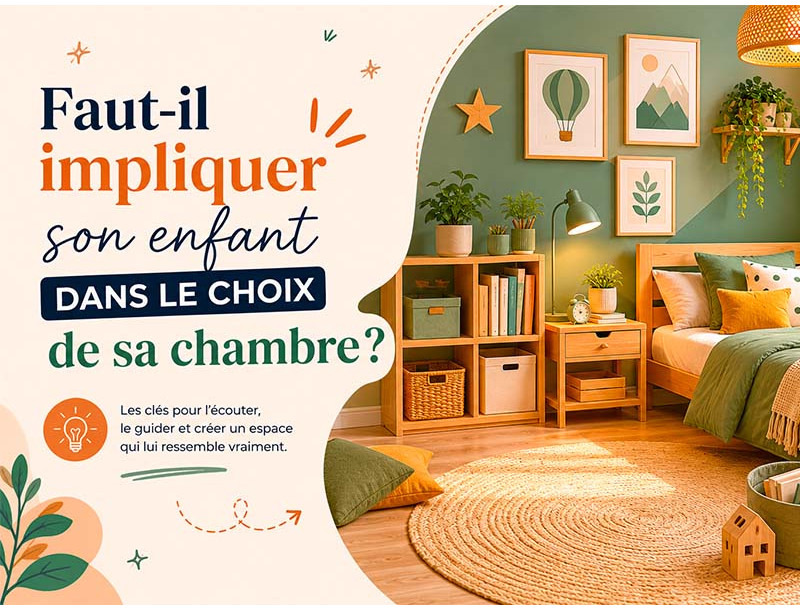
Should we involve his child in choosing his room?
Children's room & layout
Provide the space of a toddle often represents a real logistical challenge for parents. Yet, for the child, it is also a first important step towards more autonomy. Many adults hesitate: Should we leave a young child to participate in the choice of his room, or does it risk transforming the room into a happy little functional disorder?
In reality, the entire challenge is to find a good balance. Give a place to the child in decisions does not mean letting him choose everything. With a clear setting, this involvement can become an excellent educational opportunity. It allows the child to feel listened, while helping parents preserve the security, coherence and functionality of the room.
To remember
Involving a child in the planning of his room can strengthen his autonomy and his feeling of security.
However, the parent keeps a key role in supervising choices and ensuring security, quality and functionality.
The limited choice method works very well with toddlers: two or three options are large enough.
The bed remains the central element of the room, both convenient, reassuring and carrier of imaginary.
A model like the children's cabin bed can accurately help reconcile parents and enthusiasm of the child.
Psychological benefits: autonomy, trust and sense of security
Allow a toddle to participate in the development of its space is not a simple aesthetic caprice. It is also a very interesting development lever. When a child feels associated with this project, he understands that his opinion counts. His room then becomes a more familiar place, more reassuring and easier to invest on a daily basis.
Conversely, a room entirely thought by adults can sometimes be lived as an imposed space. When he participates, even modestly, the child develops a more personal relationship with this new universe. This can help him tame the evening separation and better accept rest times in his own room.
Self-esteem
Understand that his opinion is heard gives the child a real sense of recognition and pride.
Accountability
A child often takes care of a space he has helped to imagine or customize.
Reduction of anxiety
One room chosen partly with him can become a more predictable cocoon and therefore more soothing at bedtime.
Sense of belonging
The child no longer succeeds in a decor: he feels at home in a space thought also for him.
How to pose a frame without brightening the child ?
Involving your child does not mean to give him white card. For the room to stay pleasant to live, secure and sustainable, the role of the adult is to organize upstream choices. This can be called the supervisory choice or the controlled choice. The parent selects the realistic options, then leaves the child slice between two or three adapted possibilities.
This method avoids saturating the attention of the toddler and limits unrealistic decisions. A young child does not yet have the benchmarks related to the budget, security, ergonomics or sustainability of furniture. On the other hand, it is quite capable of expressing a preference for a color, an atmosphere, a decorative detail or the place of certain familiar objects.
The right method: propose little, but offer just
In fact, the best approach is to preselect options according to specific criteria. Parents first validate the essential elements: furniture safety, material quality, ease of maintenance, stability, adaptation to the age of the child and coherence with the room. Then only, the child intervenes on targeted choices.
For example, rather than asking "what bed do you want? ", It's often more wise to ask" do you prefer this model in white or natural wood? ". The child then feels a real decision-making power, while remaining in a reassuring and realistic setting. This approach promotes cooperation without losing their role as a referent.
Practical checklist to involve his child without disorganizing the room
First define non-negotiable items: safety, size, strength, quality
Offer only two or three options at each step
Let the child choose visual details rather than the whole structure
Keep global coherence in colors, volumes and uses
Provide an easy room to evolve with age
Involving the child in final implementation: Plush, cushions, reading, decoration
Value your choices to strengthen his sense of belonging to his new space
The cabin bed: an ideal compromise between imagination and security
The bed occupies a central place in a child's room. It is both a furniture, a strong visual mark and a place responsible for emotional. For parents, it must be stable, securing and adapted to the age of the child. For the latter, it must also be attractive, fun and easy to appropriate. This is precisely for this reason that the child's cabin bed often appears as an excellent compromise.
Its structure evokes a refuge, a small house or a personal cocoon, which stimulates the imagination without neglecting adult safety and functionality expectations. Placed in the heart of the room, it can become the ideal starting point for a common project: parents validate the quality of the model, while the child is projecting into a universe that looks like him.
Why this involvement can facilitate bedtime
The time of bedtop often crystallizes many emotions among young children. A room too impersonal or little invested can reinforce the difficulty of evening separation. Conversely, a room in which the child took part in some decisions becomes more familiar. She is not only "the room we made", but a space he has learned to recognize and love.
This is obviously not a miracle solution to all sleep disorders, but it can clearly help make the transition softer. When the child finds a universe that he has been involved in building, sleeping can become more serene and predictable.
FAQ
From how old can a child participate in the choice of his room ?
From an early age, a child can express simple preferences. It does not need to decide everything to be involved: choose between two colors or two atmospheres can already suffice.
Does not risk losing the control of the decoration ?
No, if the parents frame the choices from the start. The principle is precisely to leave a place to the child in a prepared and controlled setting.
What elements can we let him choose easily ?
Colors, some accessories, plush place, bed linen, some decorative elements or the general room of the room are often good starting points.
Why is the bed so important in this project ?
Because it visually structures the room and plays a strong role in the child's report in his room. A well chosen bed can help make this space more reassuring, more attractive and more personal.
The word of the end
Involving his child in choosing his room can be a very nice way to accompany him to more autonomy, provided that parents keep a clear setting. Balance is often found in a simple distribution of roles: adults technical and security decisions, the child personalization and appropriation of the place.
When this transition is thought like a shared project, the room does not just become a pretty or practical space: it becomes a real cocoon, both reassuring, functional and bearer of beautiful projections for the child as for his parents.
This article has an informative aim and does not replace the advice of a early childhood professional or a planning specialist. For any choice of furniture, always make sure to check compliance, safety and adaptation to your child's age.