
Shopping Cart
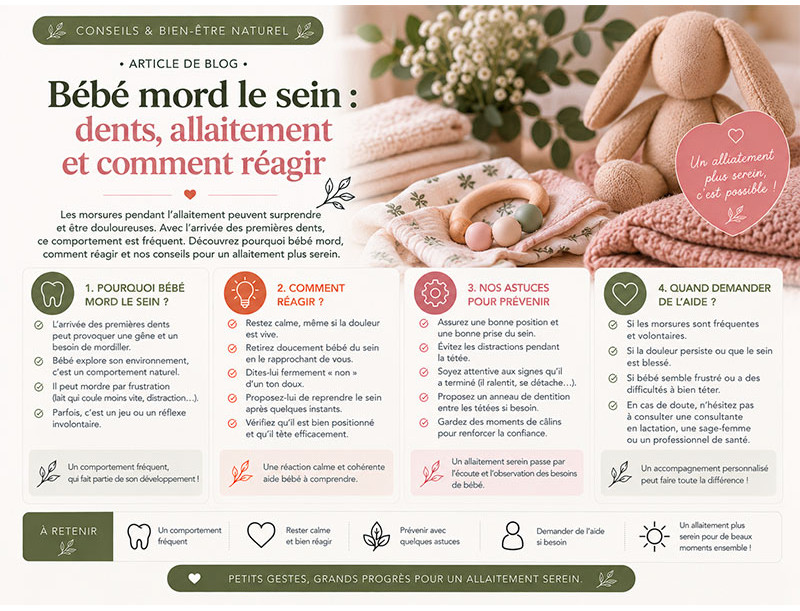
Baby Bites the Breast: Teeth, Breastfeeding, and How to Respond
Breastfeeding & Teeth
The first bite always comes as a surprise—and it hurts. It often happens between 4 and 8 months, when the gums are teething and the baby discovers that he or she can bite down. Many mothers then wonder if breastfeeding is coming to an end, if they’ve done something wrong, or if teeth and the breast are simply incompatible. None of these three ideas is correct. A baby who latches on correctly cannot bite; a bite almost always has an identifiable cause, and it goes away within a few days once you know how to respond.
Baby Biting the Breast: Why It Happens and How to Stop It
A baby who is actively nursing cannot bite: his tongue covers the lower gum, and the nipple is far back in his mouth. Biting therefore occurs when the baby is no longer nursing—most often at the end of a feeding when the milk flow slows down, or when the baby is distracted, or during teething, when the baby needs to soothe its gums. It does not signal the end of breastfeeding or a rejection of the breast.
The right response consists of three steps: stay as calm as possible, break the latch by sliding a finger into the corner of the baby’s mouth or by bringing the baby closer to the breast so that he or she opens it, and then briefly interrupt the feeding with a firm “no.” A loud scream can frighten the baby so much that he or she refuses the breast for several days. As a preventive measure, offer a cold teething ring before feeding, minimize distractions, and remove the baby as soon as sucking stops. Most biting episodes stop within a few days using this method.
Key Takeaways
Biting and sucking are anatomically incompatible: a baby bites when it is no longer sucking, never while sucking.
The most common causes are the end of a feeding, teething, distraction, and a stuffy nose.
Staying calm and stopping the feeding is more effective than yelling, which can lead to a nursing strike.
Teeth are not a reason to wean: many babies continue to breastfeed for several months even after all their teeth have come in.
A bite wound can be treated with a few simple steps; seek medical attention if it becomes infected or does not heal.
Why can't a baby who is nursing bite ?
Understanding the mechanics of breastfeeding changes everything. When a baby nurses effectively, the nipple is drawn deep into the mouth, all the way to the junction between the hard and soft palates, and the tongue extends over the lower gum to press against the breast in a wave-like motion. In this position, the gums—and later the teeth—cannot close around the nipple: the tongue acts as a barrier. This is why a mother does not feel the baby’s teeth during a proper feeding, even when four incisors have come in.
To bite, the baby must first pull back the tongue and move the nipple toward the front of the mouth. In other words, the baby must have stopped suckling. A bite is therefore not an accident that happens in the middle of a feeding: it’s a signal that the feeding is over, or that it has been interrupted by something else. Knowing this helps you identify risky situations and take action before the baby’s teeth close.
She also explains why biting tends to occur at certain times: at the end of a feeding, when the milk flow slows down and the baby falls asleep or is playing; distracted feedings, when a noise or a sibling walking by makes the baby turn its head without letting go; and teething periods, when pressure on the gums provides relief and the baby tries to bite anything within reach.
End of a feeding session
The flow slows down; the baby is done and is playing. Remove the bottle as soon as the sucking stops, without waiting.
Teething
His gums are itchy. A cold ring before a feeding helps keep him from wanting to bite.
Distraction
He turns his head without letting go. We nurse calmly, in a quiet room, maintaining eye contact.
Stuffy Nose
He can't breathe while feeding and lets go when he clamps down. Rinsing his nose before each feeding solves the problem.
Common Causes of Bites and How to Prevent Them
The first cause is the end of a feeding. The baby has had enough, the milk flow has slowed, and the baby stays at the breast for comfort or because he or she is falling asleep. That’s when the baby pulls his or her tongue back and the gums come together. Prevention is simple: watch for the sucking rhythm and remove the baby as soon as the swallowing movements become noticeably less frequent, rather than letting him doze off at the breast. You can offer him the other breast if he still seems hungry, or simply end the feeding.
The second cause is teething. Most often between 4 and 8 months, the gums swell, and applying pressure provides relief: the baby bites everything, including the breast. Offering a teething ring that’s been chilled in the refrigerator right before a feeding, or gently massaging the gums with a clean finger, can calm the urge to bite before it even starts. To recognize the signs of teething and learn how to soothe your baby, check out our article on teething explains what actually works.
The third cause is distraction, which is very common around 5–6 months of age, when babies are interested in everything around them. They turn their heads to look around without letting go of the nipple, and their gums close around it as they do so. Feeding in a quiet place, away from the TV and siblings, using a nursing necklace or making eye contact with the mother to capture the baby’s attention, significantly reduces these incidents. Finally, a stuffy nose prevents the baby from breathing while nursing: the baby suddenly lets go while clenching. Rinsing the nose with saline solution before a feeding is often enough to stop the biting that was thought to be related to teething.
What if the baby bites just to play ?
This does happen, especially after 8–9 months, when the baby has figured out that biting causes a reaction. He tests the waters, watching for the startled reaction, sometimes while laughing. It’s not out of malice; it’s an experiment in cause and effect. The response is the same as for other triggers, with one key consistency: every bite stops the feeding—calmly, without exception—and within a few days, the baby learns that biting means the end of nursing.
How should you react in the moment ?
The first instinct is to pull the baby away, and that’s the worst thing you can do: the nipple, trapped between the gums, gets stretched, causing even more pain. There are two techniques for freeing the breast without causing harm. The first involves sliding a clean finger into the corner of the baby’s mouth, between the gums, to break the suction and gently open the jaw. The second, more surprising technique involves bringing the baby closer to the breast rather than pulling them away: with their nose against the breast, they’ll open their mouth to breathe and let go. Many mothers find the second method faster, especially with a baby who latches on tightly.
Next comes the emotional reaction, and it matters more than we realize. A cry of pain is natural, but a loud cry or a sudden startle can frighten the baby so much that he or she refuses the breast for several days—a phenomenon known as a “breastfeeding strike.” Whenever possible, take a deep breath, remove the baby, set them down or hand them to someone else for a few moments, and say, “No, that hurts,” in a calm but firm voice. The baby doesn’t need to be punished—he needs a clear and repeated signal.
Stopping the feeding is that signal. After a bite, stop the feeding for one or two minutes—without getting angry—and then resume if the baby asks for it. Repeated every time the baby bites, this sequence teaches the baby within a few days that biting makes the breast go away, and that nursing keeps it there. This is the most effective learning method known, far more so than scolding or startling the baby.
Treating a Nipple Injured by a Bite
A bite can leave a red mark, a small cut, or a crack. Most heal within a few days with simple care: after feeding, spread a few drops of breast milk on the nipple and let it air-dry; apply pure lanolin or a breastfeeding balm that’s safe to use while nursing; avoid drying soaps; and change nursing pads often to keep the area dry. Washable cotton or bamboo, which are softer and more breathable than plastic-coated disposable ones, reduce friction on sensitive skin.
While the nipple is healing, you can start feeding on the least painful breast—when the baby’s suction is strongest—and vary your feeding positions so that pressure isn’t always applied to the same spot. If pain makes breastfeeding impossible on one side, pumping milk from that breast for one or two days will help maintain your milk supply while the skin heals.
Certain signs warrant seeking immediate medical attention: a sore that doesn’t heal within a week, a spreading, warm rash, discharge, a fever, or pain that persists between feedings. An infected cracked nipple or mastitis is much easier to treat when caught early. A lactation consultant or midwife can also check the latch, as repeated biting may sometimes be a sign that the latch has deteriorated over time.
Should you wean your baby when their teeth start coming in ?
No, and that’s probably the most important message in this article. The idea that teeth put an end to breastfeeding is a persistent, unfounded belief. Millions of mothers breastfeed babies who have teeth—often until they’re two years old and beyond—without being bitten. Teeth do not play a role in breastfeeding: it’s the tongue that does the work, and the teeth stay out of the way as long as the baby is nursing.
Biting episodes are almost always temporary, related to teething or a phase of exploration, and they stop within a few days to a few weeks with a consistent response. The decision to stop breastfeeding remains a personal choice, one that is valid at any time, but it should be made for sound reasons, not in the heat of the moment because of a bite. If the situation becomes overwhelming, a consultation with a lactation consultant can often resolve the issue in a single session.
Bite Prevention Checklist
Offer a cold teething ring before a feeding when your baby is teething
Clean your baby's nose if it's stuffy, so they can breathe while nursing
Breastfeed in a quiet place, maintaining eye contact
Remove the baby as soon as the sucking slows down, before the baby falls asleep or starts playing
If the baby bites: Place your finger in the corner of the baby’s mouth or bring the baby closer to the breast—never pull the baby away.
A calm "no," with the feeding paused for one or two minutes each time
Treat the nipple with breast milk, lanolin, and clean, dry nursing pads
FAQ
At what age does a baby start biting the breast ?
Most often between 4 and 8 months, when the first teeth come in and the baby discovers that he or she can bite. Some babies bite even before their teeth come in—using their gums—while others never bite at all.
My baby has been refusing to breastfeed ever since I yelled—what should I do ?
This is a nursing strike, a common reaction after a scare. It usually resolves within a few days: offer the breast without insisting, in a calm setting—often when the baby wakes up or is drowsy—increase skin-to-skin contact, and pump milk in the meantime to maintain milk supply.
Can I continue to breastfeed if I have a sore nipple ?
Yes, in most cases, starting with the least painful breast and alternating positions. If the pain is too severe, pumping milk from the affected side for one or two days will help maintain milk production while the wound heals.
Do bites mean that the baby wants to stop breastfeeding ?
No. They indicate the end of a feeding, teething, distraction, or a stuffy nose—never a desire to wean. With a consistent response, they disappear within a few days, and breastfeeding continues as usual.
A Final Word
A bite on the breast hurts, comes as a surprise, and is worrisome, but it’s nothing to worry about. Babies bite when they’re done feeding—for a reason that’s almost always identifiable—and they quickly learn that biting makes the breast go away. A few days of consistent effort are usually enough to make feedings peaceful again, teeth or no teeth.
At Maman et Bébé Nature, we believe that well-supported breastfeeding gets you through every stage, including teething. A teething ring, a little lanolin, soft nursing pads, and plenty of calm—that’s often all it takes.
This article is intended for informational purposes only and is not a substitute for the guidance of a lactation consultant, midwife, or doctor. If you have a nipple sore that won’t heal, spreading redness, a fever, or persistent pain between feedings, seek medical attention promptly.