
Shopping Cart

How to dress your baby at night: the right gear for every room temperature
Baby sleep and nightsUpdated November 26, 2026
It is the question that comes back every evening, and even more once the heating goes back on: is my baby warm enough, or too warm? The answer has little to do with how many clothes you pile on. It starts with the temperature of the room, then a suitable sleep sack, and finally a detail that almost everyone forgets: the diaper, which has to last until morning without waking anyone up.
18 to 20 °Cin the bedroom, winter and summer
+1 layercompared with what you are wearing
Empty cribno blanket, no pillow, no hat
Dressing your baby at night: what you adjust in the room and what you adjust on your baby
The starting point is the temperature of the room: between 18 and 20 °C, according to both the French national health insurance (Assurance Maladie) and the French National Authority for Health (HAS). Once that is set, the outfit follows: above 24 °C, a short-sleeved bodysuit is often enough; between 22 and 24 °C, add a light sleep sack; between 19 and 21 °C, light pajamas under a mid-season sleep sack; below 19 °C, pajamas under a thicker sleep sack. The American Academy of Pediatrics sums up the dressing rule in one sentence: only one layer more than you are wearing yourself.
Three things have no place in the crib: blankets, pillows and hats, even when it is cold. The HAS rules out duvets, blankets and any object that could cover the child, and the American Academy of Pediatrics advises against hats indoors once you are home from the hospital. To check that the outfit is right, place your hand on the back of the neck: it should feel warm and dry, with no sweat under your fingers.
Key points
✓Set the room to 18 to 20 °C before deciding how to dress your baby.
✓One layer more than you in the same room, never two or three.
✓No blanket, no pillow and no hat in the crib: the sleep sack replaces all of them.
✓The back of the neck tells you more than the hands and feet, which are naturally cooler.
✓A full night needs a diaper designed for it, otherwise your baby wakes up because of wetness rather than cold.
The golden rule: room temperature comes before the outfit
Many parents look for the perfect combination of clothes when the real lever is elsewhere. A room at 23 °C makes any warm pajamas uncomfortable, and a room at 16 °C makes even the best sleep sack insufficient. The 18 to 20 °C benchmark applies all year round, not just in winter, and the Assurance Maladie also recommends airing the bedroom every day.
A room thermometer placed at crib height, away from the radiator, settles the question once and for all. It is a small purchase that saves a lot of guesswork, especially in attic bedrooms or south-facing rooms, which are often warmer than the rest of the home.
The dressing rule then follows from that number: one layer more than you, not two, not three. It is the temptation to add more “just in case” that leads to overheating, and the Assurance Maladie specifically advises against piling on layers of clothing.
Above 24 °C
A short-sleeved bodysuit, possibly under a very thin muslin sleep sack.
0.5 TOG or less22 to 24 °C
Short-sleeved bodysuit and a light sleep sack.
0.5 to 1 TOG19 to 21 °C
Light pajamas under a mid-season sleep sack.
1 to 2 TOGBelow 19 °C
Pajamas and a thick sleep sack. Go up in TOG, never add a blanket.
2 to 2.5 TOGThese are guidelines: temperature ranges vary slightly from one brand to another, so follow the chart printed on your sleep sack's label.
When it is cold: layer up without covering the head
In cold weather, thin layers are still the right reflex: a long-sleeved bodysuit, suitable pajamas and, on top, a sleep sack that fits your baby's size. If it is too big, your baby can slip down inside it, as the Assurance Maladie points out; if it is too small, it restricts the legs. Choose the thickness by TOG rating rather than by eye: it is the only figure you can compare from one model to another.
If the room drops well below 18 °C, the answer is not to pile more onto your baby but to deal with the room: close the shutters, seal a drafty window, move the crib away from a cold wall or turn the heating up slightly. An extra piece of clothing makes up poorly for an under-heated room, and it quickly becomes too much if the temperature rises during the night.
Why no hat and no blanket in the crib
This is where intuition most often goes wrong. Putting a hat on your baby for sleep seems logical when it is chilly, yet it is not recommended: in its guidance against overheating, the American Academy of Pediatrics asks parents not to put a hat on their baby indoors once they are home from the hospital. Keep the hat for outings and take it off as soon as you get home.
The same logic applies to blankets, duvets, pillows, crib bumpers and soft toys. The HAS and the French national professional council of pediatrics rule them out because they can cover the face or trap the air around the child. The sleep sack exists precisely to replace them. For all the safe sleep rules, our article on co-sleeping and safe sleep explains what is recommended and what is not.
When it is hot: lighten up without giving up the sleep sack
Above 22 °C, switch to a short-sleeved bodysuit with light pajamas or a thin sleep sack. Above 24 °C, the bodysuit alone is usually enough. Cotton, bamboo and muslin absorb sweat better than synthetic fibers, which keep it against the skin.
During a heat wave, airing the room in the cool hours and keeping the shutters closed during the day does more for your baby's comfort than any choice of pajamas. And if the room still stays above 24 °C, it is better to choose a lighter sleep sack than to do without one: it remains the way to cover your baby without a sheet or blanket.
What if your baby likes to feel snug?
Some babies fall asleep more easily when they feel wrapped up, especially in the first weeks, when the Moro reflex startles them awake. A sleep sack that fits well at the shoulders already provides much of that snug feeling while leaving the legs free to move.
If you choose to swaddle, two rules are non-negotiable: your baby always sleeps on their back, and you stop as soon as they try to roll over. The American Academy of Pediatrics places this milestone around 3 to 4 months, sometimes earlier, and points out that swaddling does not reduce the risk of sudden infant death. If in doubt, your midwife or pediatrician will give better advice than anything found online.
The night diaper: the forgotten link
You can set the room to the exact degree and choose the right sleep sack, and still see your baby wake up. Often, the culprit is neither cold nor heat: it is a diaper that has reached saturation. A night lasts much longer than the time between two daytime changes, and a diaper designed for the afternoon cannot go the distance. Leaks, pajamas to change in the middle of the night and soaked sheets often come from there.
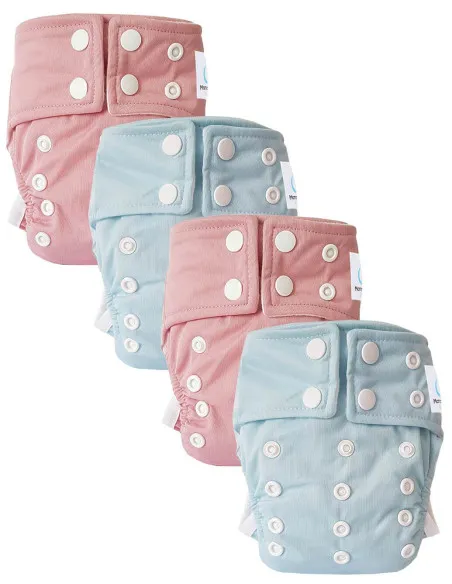
This is exactly what all-in-one cloth diapers solve. In these models, the absorbent insert is sewn into the diaper, so there is nothing to assemble at changing time, which matters when you are changing a half-asleep baby in the dark. In the Maman et Bébé Nature range, this insert has five layers, under a bamboo charcoal lining with a stay-dry effect in the classic collection, or a microfleece lining in the Sensitive collection, certified Oeko-Tex Standard 100 class 1. A pocket at the back lets you add an extra insert for heavy wetters, and the double leg gussets act as a barrier against leaks. Rows of snaps adjust the diaper from 3 to 15 kg, and a Newborn version covers the first six months.
The one thing to plan for is drying. Because all the layers are sewn together, an all-in-one dries more slowly than a diaper with a separate insert. Dry it out of direct sunlight, which damages the waterproof PUL layer, and keep a few extra diapers in rotation if you do not have a dryer. We recommend keeping all-in-ones for nights and using a faster-drying model during the day.
Our selection of all-in-one cloth diapers for the night
From the complete kit to get started to the pack designed for newborns, these are the all-in-ones we recommend for nights.
The complete kitPremium All-in-One Bamboo PackEverything you need to switch to cloth diapers at night in a single order, with extra inserts to boost absorption for heavy wetters.✓10 bamboo all-in-one pocket diapers✓10 bamboo and microfiber inserts with 4 layers, to slip into the pocket✓1 waterproof bag with two zipped pockets for outings✓200 bamboo viscose diaper linersDiscover the pack →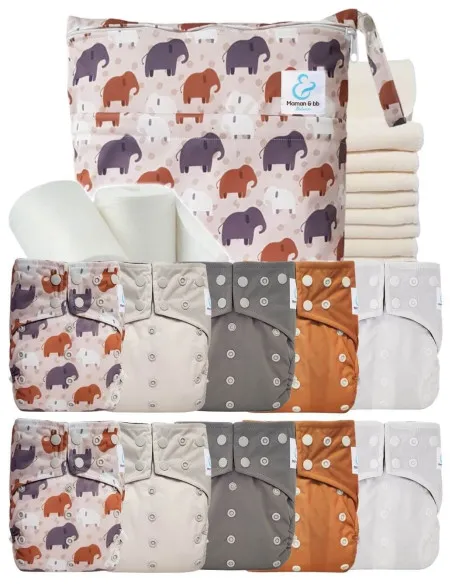
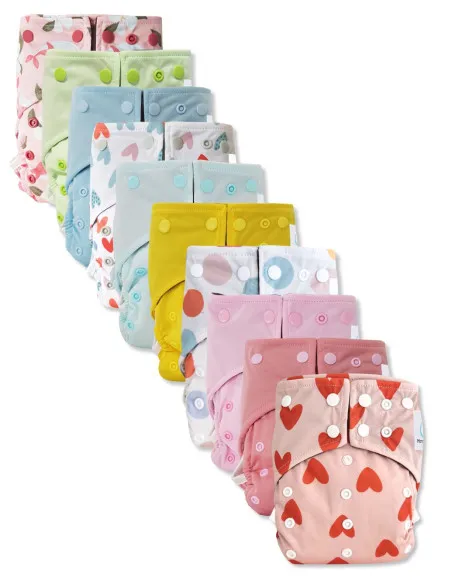
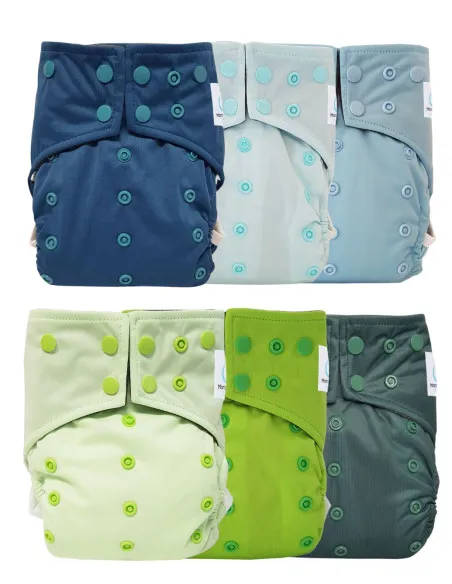
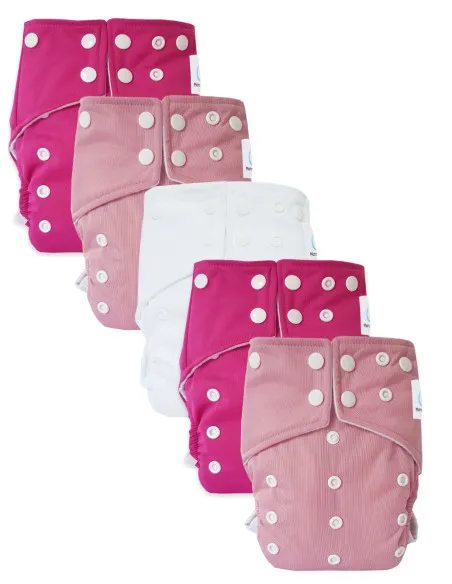
Want to try one before stocking up? The all-in-one is also sold individually, like the Aaron the Lion diaper.
The full range
All-in-one cloth diapers, designed for nights
Built-in five-layer insert, stay-dry lining and snaps that grow with your baby: sold individually, in kits of 6, packs of 10 or as a complete pack.
Checking that the outfit is right
The test takes five seconds: slide your hand onto the back of your baby's neck or between the shoulder blades. The skin should be warm and dry, and the Assurance Maladie puts it simply: you should not feel any sweat under your fingers. If the neck is damp or clearly hot, remove a layer; if the upper back feels distinctly cool, add one. Hands and feet are naturally cooler in infants, and relying on them often leads to overdressing.
The signs of overheating are worth knowing: the American Academy of Pediatrics lists sweating, a chest that feels hot and flushed skin. If you notice them, uncover your baby right away. One last common-sense check: if you feel hot in the room yourself, your baby is hot too.
Bedtime checklist
✓Room between 18 and 20 °C
✓Only one layer more than you
✓Sleep sack chosen by TOG rating and your baby's size
✓Hat taken off before bedtime
✓Empty crib: no blanket, pillow, bumper or soft toy
✓A diaper designed to last all night
✓Baby on their back, on a firm, flat mattress
✓Warm, dry neck before you leave the room
Dressing your baby at night: your questions
What temperature should a baby's room be at night?
Between 18 and 20 °C all year round, according to the Assurance Maladie and the HAS. Measure it with a room thermometer placed at crib height, away from the radiator, and air the room every day.
Should my baby wear a hat to sleep when it is cold?
No. The American Academy of Pediatrics advises against hats indoors once you are home from the hospital, and the HAS rules out anything that could cover the child in the crib. If the room is too cold, adjust the room and the thickness of the sleep sack.
How can I tell if my baby is too hot at night?
Feel the back of the neck: warm and dry means all is well; damp or hot means you should remove a layer. Sweating, a hot chest and flushed skin are the signs of overheating listed by the American Academy of Pediatrics. Cool hands or feet are not a reliable indicator.
How should I dress my baby at night when it is hot?
Above 22 °C, a short-sleeved bodysuit and a light sleep sack; above 24 °C, the bodysuit alone is usually enough. Choose cotton, bamboo or muslin, and cool the room by airing it in the cool hours.
Which cloth diaper is best for nighttime?
An all-in-one diaper, with the absorbent insert sewn in. On our models it has five layers, a back pocket lets you add a booster insert and double leg gussets help prevent leaks. The Sensitive version is Oeko-Tex Standard 100 class 1 certified, and the Newborn version adjusts from 0 to 6 months.
Final word
Dressing your baby at night comes down to three settings, in this order: the room temperature, the thickness of the sleep sack, then the diaper. Everything else, the little blanket added just in case or the hat left on after a walk, leads to overheating more often than to comfort.
At Maman et Bébé Nature, we prefer nights that work without improvising: a room at the right temperature, an empty crib, a sleep sack chosen by its TOG rating and a diaper made to last until morning.
Sources and method
Article updated on November 26, 2026 by the Maman et Bébé Nature team, a shop specializing in cloth diapers and baby care. The temperature, dressing and safe sleep guidelines are based on:
- French national health insurance (Assurance Maladie), “Comment bien coucher un bébé ?”, ameli.fr
- French National Authority for Health (HAS) and French national professional council of pediatrics, memo sheet on preventing positional skull deformities and sudden unexpected infant death, February 2020
- American Academy of Pediatrics (AAP), “A Parent's Guide to Safe Sleep”, healthychildren.org
Diaper features come from the product pages of our shop.
This article is for information only and does not replace medical advice. Sleeping on the back, on a firm, flat mattress, in a crib free of any objects, remains the recommended setup for infant sleep. If you have doubts about how your baby tolerates heat or cold, if sleep is very disrupted or if you notice anything unusual, ask your doctor, pediatrician or midwife for advice.