
Shopping Cart
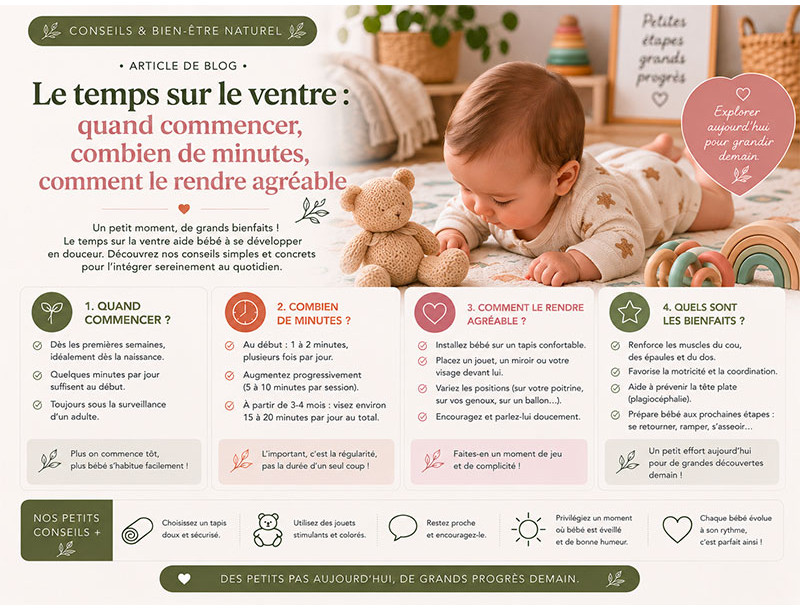
Time on the stomach: when to start, how many minutes, how to make it nice
Awakening & motor skills
Since we lay the babies on the back to sleep, a recommendation that has dropped sudden infant death, another question has been imposed on them: how to offer them time on the stomach during the day? This moment, called "Tummy Time" in English-speaking countries, has become a pillar of engine development. It strengthens the neck and back, prepares the turnaround and walking on all fours, and limits the flattening of the skull. Yet many babies protest as soon as they are put on his stomach. Here's when to start, how long a target at each age, and especially how to transform this apparent chore into play.
Time on the stomach: Age and duration landmarks
Time on the stomach can begin from the first days of life, two to three minutes several times a day, always when baby is awake, calm and under surveillance. It is gradually increased to about fifteen to thirty minutes cumulative per day to two months, then around a cumulative hour, spread in several short sessions, around three or four months. The fundamental principle remains: on the back to sleep, on the belly to play.
The first few weeks, the easiest position is not the carpet, but the torso of the extended parent, where baby naturally raises his head to watch a face. On the ground, a pudding or a towel rolled under the chest, an unbreakable mirror and an adult at its height change everything. Two signals justify talking to the doctor: a head always turned on the same side or a visible flattening, and a baby who does not hold his head at all around three or four months.
To remember
We start from birth, on the torso of a parent, a few minutes at a time.
These are the short and frequent sessions that count, not a long daily session.
The time on the belly is always awake and monitored: never to sleep, never without an adult present.
The tears of the first times are normal: we write, we varies the positions, we try again later.
Portage and position changes over the day also count as time out of the back.
Why did the time on the belly become so important ?
The Baby Baby Recommendation, widespread in the 1990s, divided by several the number of sudden infant deaths. She had a well-documented side effect: babies now spend most of their days on the back, bed, sunbed, cozy or stroller. Two consequences followed. On the one hand, a net increase in the positional plagiocephaliaphalies, these flattenings of the rear or side of the skull related to prolonged support always in the same place. On the other hand, a slight delay in early motor acquisitions in babies who never have the opportunity to practice belly.
The time on the belly meets these two issues. On the belly, baby must fight the gravity to raise the head: it strengthens the muscles of the neck, shoulders, back and trunk. These are exactly the muscles he will use to turn around, sit down, crawl and walk on all fours. He also discovers another view of the world, learns to push on his arms and move his weight, as many bricks of future motor skills. Finally, this time out of the back relieves the pressure on the back of the skull, still malleable the first months.
This is not a training or performance. A baby who regularly spends a few minutes on his belly every day, in good conditions, enjoys everything this position brings. No need for timer or tracking table.
0 to 1 month
Two to three minutes, three or four times a day, especially on the torso of a parent.
1 to 2 months
Fifteen to thirty minutes cumulated per day, in five-minute sessions, on the ground with a pudding.
3 to 4 months
Around a cumulative hour, baby grows on his forearms and starts to pivot.
5 months and more
Baby turns alone and chooses its position: the time on the belly becomes free ground floor.
When to start and how long at each age ?
The right answer is: from the return of maternity, and even before. A newborn posed on the torso of his elongated parent is already time on the belly. He turns his head on one side, tries to lift her a few seconds to look for the face above him, then rests it. This is exactly the expected exercise, in the most reassuring position. The first few weeks, two to three minutes, three or four times a day, are large enough.
Towards one or two months, we can go to the ground, on a firm carpet, gradually targeting fifteen to thirty minutes cumulated per day. The important word is "cumulative": six five-minute sessions are better than one thirty, which will end anyway in tears. About three or four months, most babies tolerate the position and support on their forearms: we can then approach an hour cumulative on the day, always split. These figures are benchmarks, not objectives to be achieved at all costs. A baby who protests after three minutes has not failed, it has been three minutes.
From the moment baby turns alone, from the belly to the back and then back towards the belly, usually between four and six months, the question is settled of itself: it chooses its position and the time on the belly blends into the game free on the ground.
How to make time on the pleasant belly ?
Most babies who hate belly are not opposed by nature: they are placed on the ground, alone, without anything to watch, in a position that requires an effort. Everything is played in the staging. The first lever is the moment. A calm view phase is chosen after the exchange, never just after a feed or bottle, the pressure on the belly promoting regurgitations. A tired or hungry baby will protest even though it happens.
The second lever is the height. A baby on the belly sees the floor and your feet. Lie against him, a few inches, and tell him: he will take up his head to look at you without thinking. An unbreakable mirror placed in front of it produces the same effect, just like a contrasting fabric book or a toy placed slightly in height, at the point of view but not necessarily a hand.
The third lever is support. A rolled towel or a small pudding slipped under the chest, at the armpits, with the arms that pass in front, lighten the weight on the shoulders and facilitates the recovery of the head. Some babies prefer to start on the knees of an adult sitting, or worn flat with stomach on the forearm, in position "tiger", which offers the same benefits in rocking. Finally, a firm carpet is better than a soft bed or sofa, where baby sinks and pain to push.
What if baby is crying as soon as it is put on the belly ?
We write, we never force. The time on the belly must remain associated at a nice moment, not a test. Return baby, comfort it, and try again later in another position: on you, on the knees, on the forearm. Many babies screaming to the ground very well tolerate the torso of a parent. By varying the positions and multiplying short attempts, tolerance is growing almost always in two or three weeks. The carrier carrier, which also solicits the muscles of the trunk and relieves the back of the skull, usefully complete these sessions: our article Portage in scarf when it is cool helps you take advantage of it now, as a fall approach.
Security rules never forget
Time on the belly is practiced exclusively when baby is awake and under the direct supervision of an adult. If he falls asleep on the belly, we return immediately on the back, or we put it back in bed on his back. This rule does not suffer any exception: the dorsal position for sleep is the most effective measure against sudden infant death, and time on the belly never vocal to contradict it.
The surface must be firm and unobstructed, without cushion, cover or plush near the face. It also avoids belly on an adult bed, a sofa or a sunbed, where baby can sink or slip. Finally, no time on the belly just after a meal, nor when baby is sick, cluttered or feverish: it will have enough energy to start again once restored.
When do you talk to the doctor ?
Some situations deserve a notice, not to worry, but because they are corrected as much better as they are marked early. A baby who always turns his head on the same side, who seems unable to turn it from the other or who leans permanently can present a postural torticolis, very common and well taken care of by a few physiotherapy sessions. A visible flattening of the back or side of the skull also justifies to talk about it during a visit, the sooner the best, as long as the skull is still flexible.
On the side of development, a baby who fails to take up heads around three or four months, which remains very soft or very stiff on the belly, or which shows no progression despite regular sessions, worth a professional look. These situations are rare, and the vast majority of reticient babies are just progressing with a little patience and the tips above.
Checklist for a time on the succeeded belly
Choose a moment of calm awakening, after the exchange, remote meals
Start on the torso of a parent before going on the floor
A firm carpet, cleared, without cushion or plush near the face
A towel rolled under the chest to facilitate the recovery
To put yourself at its height, to speak to him, place a mirror or a contrasting toy in front of him
Short and repeated sessions: we stop before crying
Always awake, always monitored, returned on the back if he falls asleep
FAQ
At what age on time on the belly ?
From the first days of life, on the torso of an elongated parent, a few minutes at a time. There is no minimum age: a newborn who turns his head on your chest already acts.
How many minutes a day should we target ?
A few minutes a few times a day at first, then about fifteen to thirty minutes cumulated around two months and around a cumulative hour around three or four months. Always in short and fractionated sessions, never with a treaty.
My baby hates to be on the belly, is it serious ?
No, it's very common. Vary the positions (torso, knees, forearm), choose a good time, put yourself at its height and shorten the sessions. Tolerance generally progresses in two or three weeks.
Does the time on the stomach prevent the flat head ?
He contributes strongly, by reducing the support time on the back of the skull. It combines with other position changes of the day: Portage, alternation on the side where the toys and bottle is present, and limitation of time spent in transat or in cozy out of the journeys.
The word of the end
Time on a belly is neither an exercise nor a constraint: it is a moment of play during which baby builds, at his own pace, the muscles and the supports that will bring it to his first great movements. A few regular minutes, a parent at its height and patience the days of protest are enough.
At Maman and Nature Baby, we believe in simple and repeated gestures rather than programs. On the back to sleep, on the belly to play, in the arms for the rest: it's all a baby needs to grow well.
This article has an informative purpose and does not replace a medical opinion. The durations indicated are general benchmarks, to adapt to each baby. The time on the belly is practiced only awake and under surveillance; For sleep, the position on the back remains the only recommended. In case of head always turned on the same side, flattening of the skull or doubt about the engine development of your child, talk to your doctor or pediatrician.