
Shopping Cart

My cloth diapers are leaking! What should I do?
Help, my baby's cloth diapers are leaking!!! What can I do?
Ah, leaks! Whether with cloth or disposable diapers, we've all been there at some point! While it's perfectly normal for it to happen occasionally, regular leaks are absolutely not normal. They can be caused by various factors, sometimes a combination of several at once. It is generally a problem of fit, build-up, the break-in period, or absorption capacity.
Breaking in the inserts
If you are just starting out with cloth diapers, your inserts will only be fully broken in after around fifteen washes. They can be used from about 3 or 4 washes, but will not yet have reached their maximum absorption capacity and there may be some leaks. To remedy this, we recommend doubling up the inserts during the break-in period and avoiding using them at night.
Also worth reading: How do I care for my cloth diapers?
Fitting cloth diapers:
If your inserts have been washed more than 15 times and your diapers are still leaking, the problem is most likely down to a fitting issue.
Regardless of the style, all our diapers need to be fitted and adjusted in the same way.
How do you fit a cloth diaper?
The diaper should sit below your baby's navel, there should be no gap at the thighs, and the elastics should be placed in the crease of the thighs at the groin, not overhanging onto the thighs.
The diaper should not be too tight. Microfibre inserts absorb through compression, but also release liquid through compression. This is why you should be able to fit at least 2 fingers — ideally 4 — at your child's tummy.
How do you adjust one-size cloth diapers?
It can be easy to feel overwhelmed by the number of press studs on one-size diapers. The key thing to remember is that the 3 rows of studs at the bottom are used to adjust the diaper according to your child's size (height), while the two rows at the top are used to adjust it according to their build.
To help you, here are the "standard" settings for our diapers. We recommend choosing the size that seems most suitable for your child, then fine-tuning from there. It is perfectly fine to have a diaper set to size S in height and size M at the waist. In fact, the waist tabs don't necessarily need to be symmetrical.
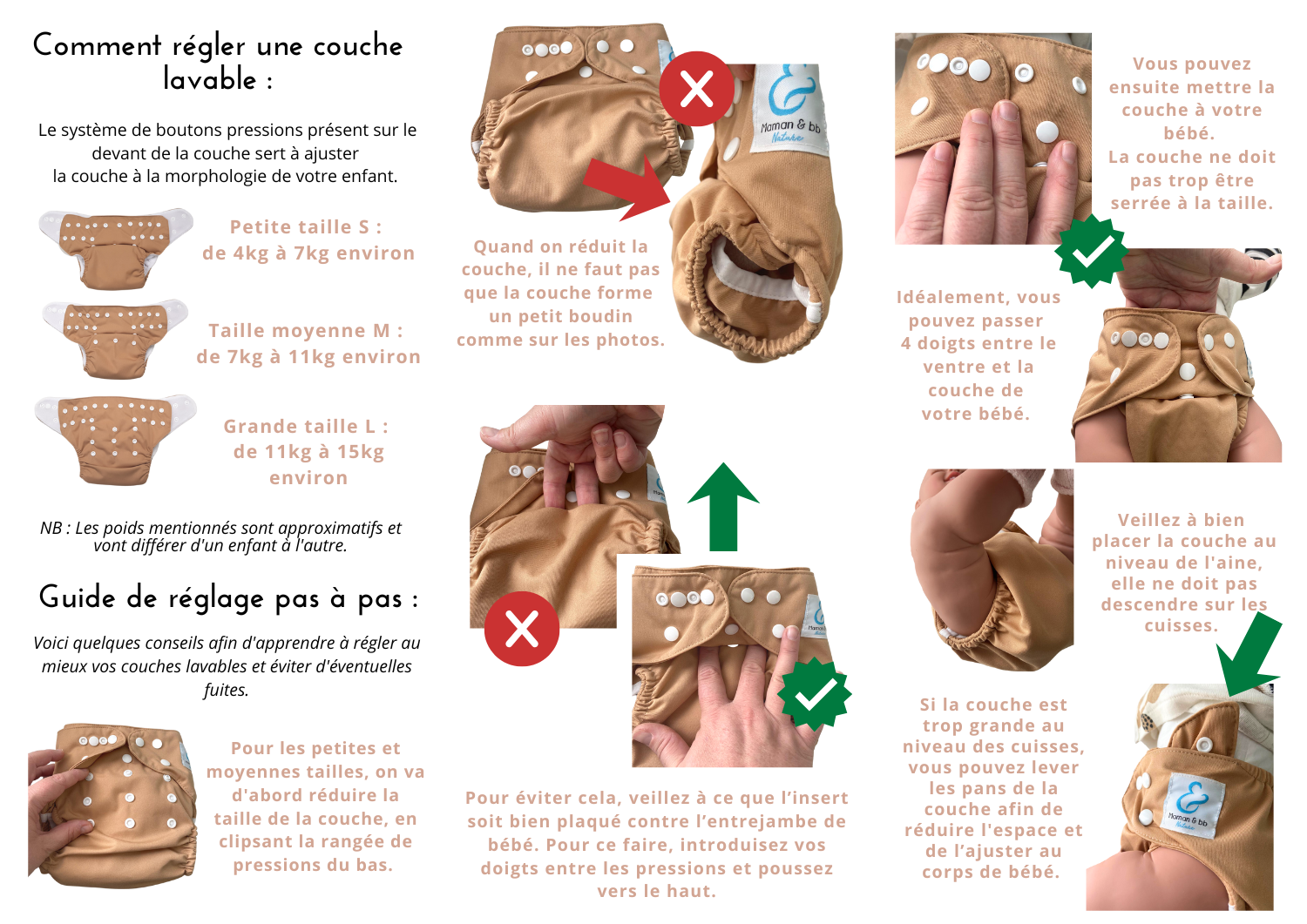
Even with the diaper set to its smallest setting, if your child still has a gap at the thighs, you can double up the insert and pull the diaper wings out to the sides (as shown in the image above).
We have put together a short guide to help you fit your cloth diapers as well as possible — feel free to download it.
Download: How to adjust your cloth diapers?
Clothing that is too tight
If your baby is between two sizes, opt for the size up for bodysuits and trousers. Most of our inserts have a microfibre core that allows for rapid absorption. However, microfibre is a material that releases liquid under compression. A bodysuit or trousers that are too tight can therefore cause leaks.
Insert absorption capacity
If the diapers were not leaking before, the problem may be related to the absorption capacity of the inserts.
As they grow, children urinate less frequently but in greater quantities. This is particularly true for bottle-fed babies, who drink larger volumes in one go compared to breastfed babies.
I therefore invite you to try using two inserts and to favour natural materials such as bamboo or cotton.
Also worth reading: A closer look at inserts!
Build-up in the inserts
If the diapers are still leaking even when you double up the inserts, they may have build-up. When this is the case, diapers can smell bad even when clean, or give off a strong ammonia smell when dirty. A diaper that smells bad even when freshly washed is a warning sign of build-up.
There are several methods for stripping your inserts. For a deep strip wash, we recommend opting for a percarbonate of soda strip wash. But if you cannot get hold of percarbonate, you can also try this other stripping method.
The main causes of leaks according to their location:
Leaks at the waist
Leaks at the back or front are most often due to a fitting issue. The diaper is usually too tight. Try undoing one press stud on one side — that should do the trick.
Leaks at the front
This is the rarest type of leak.
The first thing to do is to check whether the PUL is cracked. If the PUL is cracked, unfortunately there is nothing more that can be done for that diaper. Fortunately, this is fairly rare.
If the PUL is not cracked but the fabric is no longer waterproof, it means the inserts are no longer absorbing sufficiently. The next step is to determine whether this is a build-up issue or whether extra absorption is needed.
Baby boys tend to experience this type of leak more often than baby girls. If the problem persists even when doubling up with stripped inserts, you can try placing one insert as normal and folding a second insert that you place only at the front.
If you have Cover diapers, also make sure the insert does not move. It is important that it sits snugly against the baby's bottom.
Leaks at the thighs
These are the least straightforward to understand, but also the most common.
They can be caused by a poor fit: most often the diaper is too loose, but it can also be too tight for slightly chubby babies. They can also be caused by incorrect placement of the elastic and/or double gussets: the elastic should sit at the groin, and the double gussets should be properly tucked inside the diaper.
It is also important to make sure that the liner does not stick out of the diaper. As it becomes saturated, it can create a pathway for liquid to escape the cloth diaper.
Leaks at the thighs can also be caused by insufficient absorption, either due to build-up or because the insert's absorption capacity is not adequate. In the latter case, this tends to affect baby girls a little more often. You can start by doubling up the inserts, and if that is not enough, fold one insert in half and place it in the centre of the diaper.
Merci beaucoup je penses que les couches ne sont pas rodees Je verrais s il y a moins de fuites
Utilisées pour mon aîné pendant 2 ans, les insert étaient encrassés et on avait pas mal de fuites.... Je les ai passés au percarbonate de soude mais avec le plus jeune.... Cela fuit toujours... Je pense qu'il s'agit de la culotte en temps que telle qui n'est plus étanche.... Est ce possible ou normal après 2 ans d'utilisation ? Merci
Utilisées pour mon aîné pendant 2 ans, les insert étaient encrassés et on avait pas mal de fuites.... Je les ai passés au percarbonate de soude mais avec le plus jeune.... Cela fuit toujours... Je pense qu'il s'agit de la culotte en temps que telle qui n'est plus étanche.... Est ce possible ou normal après 2 ans d'utilisation ? Merci
Bonjour J utilise des te2 depuis un an. Mon bébé est grand et je suis passé en taille L depuis longtemps. Je double les inserts parce qu un ne suffit plus. Je les ai désencrasse deux fois déjà mais elles fuient toujours par le haut sur le ventre je ne peux plus les serrer en M en haut et j ai déjà essayé de les serrer en M en bas mais ça ne change rien.. je suis un est ce qu elles sont déjà hors service ? Le Pul a l air bon les élastiques aussi ...
Bonjour, Mon fils a 4 mois et, les couches fuit au niveau des cuisses le jour. Pourtant nous les plaçons bien comme indiqué sur le site et nous utilisons les inserts les plus absorbante en bambou. La nuit les couches fuit aussi! Cette fois dans le dos! Je change les draps tous les jours!! J'ai envie d'abandonner et de passer aux couches jetables.. Je place un dernier espoir en vos commentaires et solutions!